

What if your idle camper sitting in the driveway could pay for its own upgrades and your next three family vacations without you ever lifting a finger to clean it? It sounds like a dream, but many owners hesitate because the “what-ifs” feel too heavy. You worry about a renter hitting a pole or getting stuck in a confusing insurance claim. It’s normal to feel protective of your vehicle, especially when the legal side of things feels like a maze.
We understand that your RV is more than just a machine; it’s a vessel for family memories. You want to share that joy with others, but you need to know the legal ground you’re standing on first. This guide simplifies the renting out your RV requirements Ohio has in place for 2026. We’ll show you how to master the legal, safety, and insurance hurdles so you can stop worrying and start earning a steady income.
By the time you finish this checklist, you’ll have a clear path to compliance. We cover everything from Ohio’s specific liability minimums to the physical safety checks required for a smooth handover. We even explore how you can let a local expert handle the dirty work and logistics for you. Let’s get your RV ready for the road!
Key Takeaways
- Learn which driver’s license you need for different RV classes to keep your rental business legal and safe.
- Follow a clear mechanical checklist for tires and propane systems to protect your asset and your guests.
- Master the specific renting out your RV requirements Ohio has in place to bridge the gap between your personal policy and commercial needs.
- Find out why professional management in Holmes County is the best way to handle cleaning, dumping, and winterization.
- Prepare for seasonal demand shifts in the Midwest to maximize your income throughout the 2026 camping season.
Understanding the Legal Requirements for Renting Out Your RV in Ohio
Starting a rental business in the Buckeye State is exciting, but you have to get the paperwork right first. Ohio law views a Recreational vehicle used for income differently than one used only for family vacations. To stay protected, you must follow specific renting out your RV requirements Ohio has established for small business owners. Staying compliant isn’t just about following rules; it’s about making sure your insurance holds up if you ever need to file a claim. If the Ohio Bureau of Motor Vehicles (BMV) or your insurer finds you’re operating an unregistered commercial venture, you could face major liability gaps.
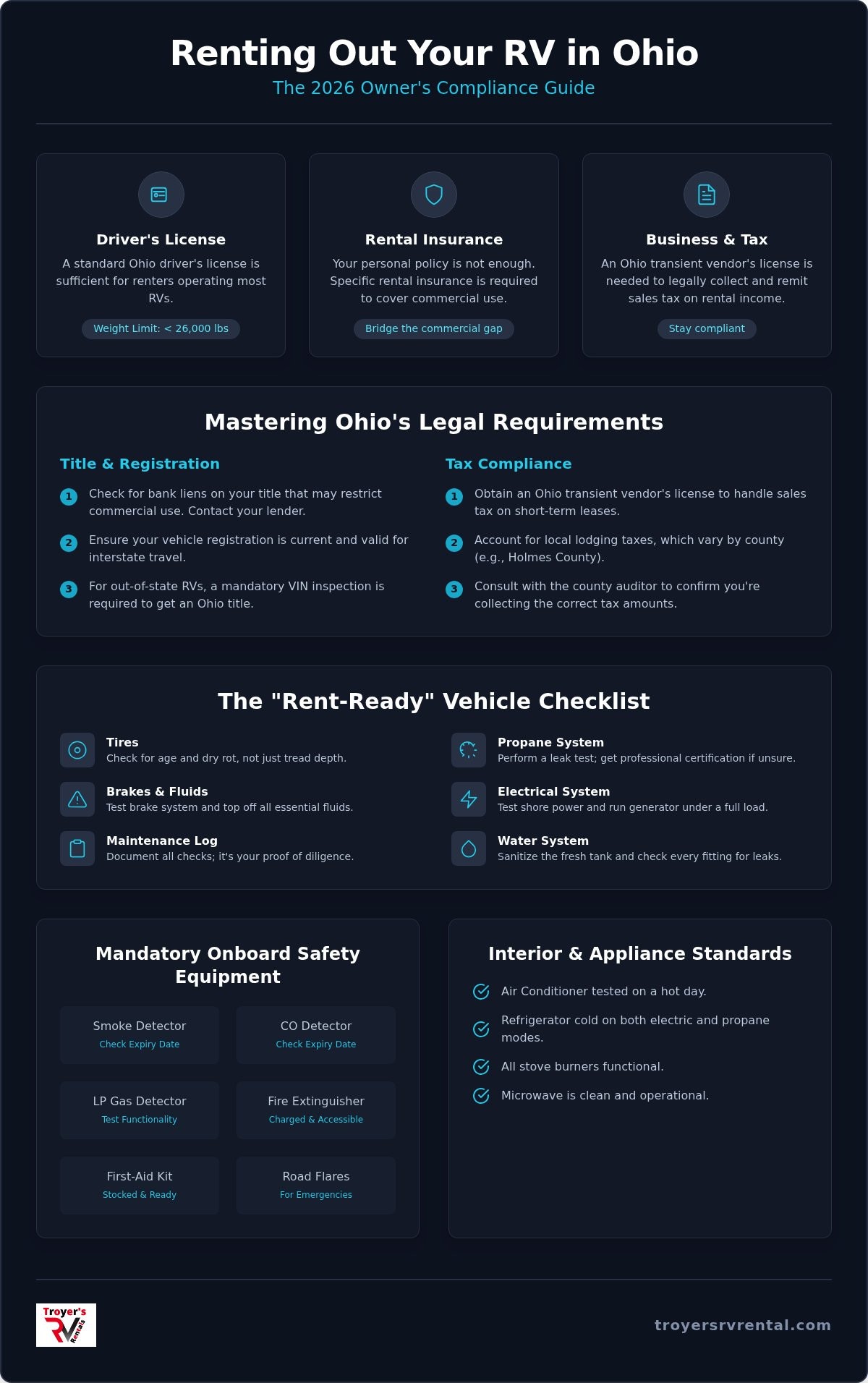
The good news is that driving requirements are straightforward. For most Class A, B, and C motorhomes, a standard Ohio driver’s license is all that’s needed. As of 2026, you don’t need a special commercial license (CDL) to operate an RV as long as it weighs under 26,000 pounds. This makes it easy for a wide range of renters to enjoy your vehicle. However, you should always verify the weight of your specific unit before listing it. Providing clear guidance to your renters about these weight limits helps build trust and keeps everyone safe on the road.
Ohio Business Registration and Sales Tax
If you plan to rent out your camper regularly, you’ll likely need an Ohio transient vendor’s license. This license allows you to legally collect and remit sales tax on your rental income. Ohio treats short-term vehicle leases as taxable transactions, so you’ll need to stay on top of these filings. If your RV is based in Holmes County, you also need to account for local lodging taxes. These local rules can vary significantly between Millersburg and other areas. We always recommend checking with the county auditor to ensure you’re collecting the right amount from your guests.
Title and Registration Nuances
Before you hand over the keys, take a close look at your RV title. If you have an active loan, your bank might have a lien that restricts using the vehicle for commercial purposes. It’s best to call your lender and ask about their policy on peer-to-peer rentals. You should also ensure your registration is fully up to date. If you’re bringing an RV into Ohio from another state to join a rental fleet, remember that a VIN inspection is mandatory before you can get an Ohio title. Keeping your plates current and valid is essential, especially since many renters will want to take your RV across state lines into Pennsylvania or Michigan.
Vehicle Safety and Mechanical Standards Checklist
Your RV needs to be more than just pretty; it needs to be “Rent-Ready.” Safety is the foundation of a good rental experience. When you review the definitions for motor homes in the Ohio Revised Code Chapter 4501, it’s clear these vehicles are complex machines designed for both travel and living. This means every system must be in top shape before a guest climbs into the driver’s seat. Meeting the renting out your RV requirements Ohio owners must follow starts with a rigorous mechanical inspection. Check your tires for age and dry rot, even if they have plenty of tread. Test your brakes and top off all fluids to ensure a breakdown doesn’t ruin a family’s vacation!
The “big three” systems—propane, electrical, and water—require special attention. You should perform a propane leak test and get a professional certification if you’re unsure about the lines. Test your shore power connections and run your onboard generator under a full load to ensure it doesn’t stall. For the water system, sanitize your fresh tank with a bleach solution and check every fitting for leaks. We highly recommend creating a standardized maintenance log. Document every oil change, tire rotation, and safety check. This log is your best friend if you ever face a liability claim; it proves you were a responsible and diligent owner.
Mandatory Safety Equipment for Ohio Renters
Don’t skip the small stuff that saves lives. Every rental must have functioning smoke, carbon monoxide, and LP gas detectors. Check the manufacture dates on the back of these units; they usually expire every five to seven years. Ensure you have a fire extinguisher that’s fully charged and easily accessible. We also suggest including a basic first aid kit and emergency road flares. These items show your renters that you care about their well-being!
Interior and Appliance Standards
Your guests expect everything to work exactly as advertised. Test the AC on a hot day and make sure the fridge stays cold on both electric and propane modes. Check every burner on the stove and ensure the microwave is clean and functional. Health compliance is also a big deal. Mattresses and upholstery must be spotless and free of allergens or pests. Finally, double-check all window and door locks. If this checklist feels overwhelming, you can always list your RV with a management team that handles these safety details for you!
RV Rental Insurance: Protecting Your Asset in Ohio
You’ve checked the tires and sanitized the tanks; now it’s time to talk about the “invisible” safety net. Many owners assume their personal policy covers a friend or a paying guest. In reality, most personal insurance companies will deny a claim the moment they find out money changed hands. This creates a massive gap that could leave you personally responsible for thousands of dollars in damages. To meet the renting out your RV requirements Ohio mandates, you must have a policy that specifically allows for commercial rental use. Always call your personal carrier first. Tell them your plans so they don’t cancel your coverage for undisclosed commercial use.
Ohio’s “implied consent” laws add another layer of complexity for owners. Basically, if you give a renter the keys, the state often views you as having given them permission to represent your interests on the road. This makes robust RV rental insurance a non-negotiable part of your business. You’ll want to understand the difference between collision coverage, which handles accidents, and comprehensive coverage. Comprehensive is vital in Ohio for things like storm damage or hitting a deer on a backroad in Millersburg. Both are essential to keep your investment safe while it’s in someone else’s hands.
Liability Coverage and Supplemental Policies
Ohio requires minimum liability limits of $25,000 for bodily injury per person, $50,000 per accident, and $25,000 for property damage. While these are the legal minimums, they are often too low for a high-value motorhome. Consider an umbrella policy to provide extra protection against major lawsuits. You should also look for “loss of use” coverage. This ensures that if a renter damages your RV and it sits in the shop for a month, the insurance company compensates you for the rental income you missed out on during that time.
Renter Screening and Documentation
Verifying who is behind the wheel is your best defense against a future claim. In Ohio, you should always check a renter’s identity and driving history for major violations. A signed, legally binding rental agreement is a must; it should clearly outline the renter’s responsibilities and your expectations. Before every handover, take high-resolution, time-stamped photos and video of the entire unit. This documentation is the only way to prove a scratch or dent wasn’t there before the trip. Following these renting out your RV requirements Ohio steps ensures you stay in control of your asset’s condition and your peace of mind.
Preparing Your RV for the Ohio Climate and Market
Ohio camping isn’t a year-round sport, but the peak seasons are incredibly rewarding. In places like Holmes County, demand spikes during the beautiful fall foliage and the spring “Amish Country” tourism rush. To succeed, you need to align your availability with these local rhythms. Meeting the renting out your RV requirements Ohio winters demand is just as important as having a clean unit for the summer. If you don’t prepare for the sub-zero temperatures, a single frozen pipe can end your rental season before it even starts. Local owners who understand these shifts can maximize their income during the high-demand months while protecting their asset during the off-season.
Winterization and Storage Requirements
Ohio winters are notoriously tough on plumbing. You must blow out the lines and use RV-specific antifreeze to prevent cracking in your tanks and pipes. Don’t forget the batteries; they should be kept on a tender or stored in a climate-controlled area to prevent them from freezing. Tires can develop flat spots if they sit on cold concrete for months, so use protective mats or jack stands if possible. Inside the unit, humidity is the enemy. Use moisture absorbers to prevent mold from taking hold while your RV sits in storage. A clean, dry unit in March is much easier to get ready for the first spring guests than one that’s been neglected since November.
Guest Experience: The “Holmes County” Touch
Most people renting in Millersburg or New Concord are looking for a relaxing escape. You can stand out by providing a local guide with your favorite Amish bakeries and scenic backroads. Stocking your unit with high-quality linens and a fully equipped kitchen makes it a “turn-key” experience that earns five-star reviews. When deciding on your fleet, consider the motorhome vs camper rental Ohio market trends to see which unit fits the local traveler’s needs best. Campers often perform well for families visiting local state parks, while motorhomes attract those on longer Midwest road trips. If you want to maximize your income without the headache of seasonal prep, list your RV with us and let our local team handle the details!
The Managed Solution: Listing with Troyer’s RV Rental
Meeting all the renting out your RV requirements Ohio demands can feel like a full-time job. Between the mechanical checks and the complex insurance filings we discussed earlier, the “passive income” dream often starts to feel like a lot of work. That’s why many local owners choose a managed solution. DIY platforms might help you find a renter, but they won’t help you scrub the bathroom or dump the black tank after a long weekend. We take that burden off your shoulders! Our team handles the “dirty work” so you can just enjoy the financial benefits.
Our management program handles the entire lifecycle of the rental. We manage the high-pressure marketing and the rigorous renter screening to ensure your vehicle stays in good hands. Because we’re a local family business, we have a reputation in Holmes County that national platforms can’t match. We also offer delivery services, which many renters prefer. This increases your occupancy rates without adding any extra miles to your engine. You get the peace of mind that comes with professional oversight and local expertise. If you’re ready to take the next step, our complete guide to RV rental management Millersburg owners rely on walks you through every detail of getting started with a local team.
How the Troyer’s Management Program Works
We start by making your RV look its absolute best. Our team provides professional photography and listing optimization to help your unit stand out in a crowded market. You don’t have to worry about where to keep your unit between trips, either. We offer secure storage at our Millersburg and New Concord locations. This keeps your driveway clear and your RV ready for its next adventure. For a deep dive into the specifics, check out our guide on how to turn your RV into income Ohio.
Getting Started: Your Next Steps
Ready to start earning? The process is simple and straightforward. First, schedule a vehicle evaluation with our team. We’ll walk through your RV together to ensure it meets our safety and quality standards. Next, we’ll review the management agreement and payout structure so you know exactly what to expect. Finally, we’ll help you prepare your RV for its first managed season. We take pride in being your partner in this journey. Let’s get your camper on the road and start building that income stream today!
Start Your RV Rental Journey Today
You now have the full roadmap for success in 2026. Navigate the legal paperwork and prep your camper for the Holmes County peak season with confidence. Mastering the renting out your RV requirements Ohio mandates doesn’t have to be a headache. It’s about protecting your asset while letting it work for you! You’ve learned how to bridge insurance gaps and keep your mechanical systems in top shape for every guest who visits our corner of the Midwest.
Don’t do all the heavy lifting yourself. Our family-owned team in Millersburg and New Concord is here to simplify everything. We handle the cleaning, storage, and renter screening. This lets you enjoy the rewards without the stress. We treat your RV with the same care we give our own fleet! Ready to turn your RV into income? Contact Troyer’s RV Rental today!
We’re excited to help you share the joy of the open road with others. Let’s make this your most profitable and worry-free season yet!
Frequently Asked Questions
Do I need a commercial driver’s license (CDL) to rent out my Class A motorhome in Ohio?
No, you don’t need a CDL for most Class A motorhomes in Ohio. As long as the vehicle’s Gross Vehicle Weight Rating (GVWR) is under 26,000 pounds, a standard Class D license is perfectly fine. This is great news for your rental business because it means more potential renters can legally operate your unit. Always check your specific unit’s weight rating on the door jamb sticker just to be absolutely sure before you list it.
Will my personal RV insurance cover me if a renter has an accident?
Most likely not, as personal policies usually exclude commercial activities. If you’re receiving money for the use of your camper, your insurer views it as a business venture. You need a specific commercial or peer to peer policy to handle these risks. Without it, you could face a total denial of coverage for damages or liability. We help our management partners navigate these insurance hurdles to ensure everyone stays protected on the road.
How much can I realistically earn by renting out my RV in Ohio?
Earnings vary based on your RV type and how often you make it available. Class A and C motorhomes typically command higher nightly rates than travel trailers. While we don’t guarantee specific income amounts, owners who list during peak seasons in Holmes County often see a steady stream of bookings. Your total income depends on factors like your vehicle’s age, amenities, and whether you offer delivery services to local campgrounds.
What are the most common RV rental requirements for owners in Ohio?
The most common renting out your RV requirements Ohio owners face include having a valid title, proper commercial insurance, and a “rent-ready” safety inspection. You must also ensure your registration is current and that you’ve addressed any manufacturer recalls. We recommend keeping a detailed maintenance log to prove the vehicle was in top shape. Providing a safe and legal vehicle is the first step toward building a successful and worry-free income stream.
Does Ohio charge a specific tax on RV rentals?
Yes, Ohio treats short term RV rentals as taxable leases. You’ll generally need to collect and remit state sales tax on every booking. Depending on where your RV is based, like Millersburg or New Concord, you might also be responsible for local county lodging taxes. It’s vital to stay compliant with these renting out your RV requirements Ohio tax rules. We can help you understand how these local and state taxes apply to your specific situation.
What happens if a renter damages my RV during their trip?
If damage occurs, you’ll rely on the security deposit and your commercial insurance policy. It’s essential to perform a thorough walk through with the renter before they leave and again when they return. Use time-stamped photos to document the condition of the unit. If you’re in our management program, we handle the entire claims process and inspection for you. This ensures that repairs are managed professionally and your asset is restored quickly.
Can I still use my RV for my own family vacations if I list it for rent?
Absolutely! You own the RV, so you get first dibs on the calendar. Most owners simply block out the dates they want for family trips well in advance. This flexibility is one of the best parts of the rental business. You can earn money when you aren’t using the camper and still enjoy your own road trips when the mood strikes. Just make sure to keep the calendar updated to avoid double bookings.
Is there an age limit for RVs allowed in the Troyer’s management program?
We generally look for well maintained RVs that are less than ten years old. Guests expect modern amenities and reliable systems when they book a rental. However, we do make exceptions for vintage units or exceptionally clean campers that show pride of ownership. We perform a full vehicle evaluation before accepting any unit into our fleet. This ensures that every RV we manage meets our high standards for safety, cleanliness, and guest satisfaction.
Comments are closed.