

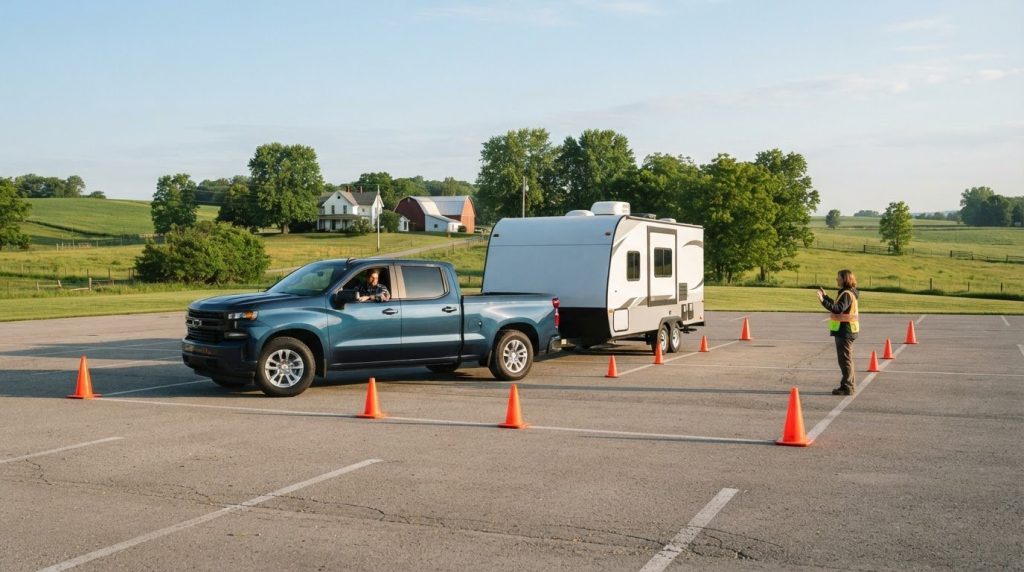
Jackknifing is easier to prevent when you make small turns and reverse slowly. The best tips for backing up a travel trailer for the first time start with a spotter, clear directions, and gentle steering adjustments. If the trailer starts angling the wrong way, pull forward to straighten out before trying again.
Backing up can feel like a lot to manage at once, especially when you’re watching the trailer, tow vehicle, and campsite. That’s normal, and practice makes the trailer’s movements easier to read. This guide covers choosing a spotter, practicing in an open space, steering while reversing, and staying calm when you need to reset. You’ll also learn what to watch for around the campsite so you can line up without sharp turns.
Key Takeaways
- Agree on clear hand signals or verbal cues with your spotter before you start, and keep them in view.
- Practice in an open parking lot with cones or other harmless markers to get a feel for the trailer’s response.
- Hold the steering wheel at the 6 o’clock position to make trailer direction easier to follow as you reverse.
- Move slowly, take a breath when tension builds, and pause to reset whenever you feel rushed.
- Use small steering adjustments to avoid a sharp trailer angle, and pull forward to straighten out when needed.
1. Is it helpful to use a spotter?
Yes. A spotter gives the driver another view of the trailer’s path and nearby obstacles. Before moving, choose one person to drive and one to spot. Agree on simple directions, such as “driver’s side” and “passenger’s side,” so “left” doesn’t become confusing from different viewpoints. These tips for backing up a travel trailer for the first time work best when both people understand the plan before the tow vehicle moves.
Before backing into a campsite, walk the route together. Look for low branches, large rocks, soft soil, and potholes. Point out the hookups and explain where you want the trailer positioned in relation to them. Check that the trailer tires can clear the campsite entrance before turning. The driver should also check the area in front of the tow vehicle, where a wide turn can bring it close to a tree or parked vehicle.
Keep the spotter visible in a rearview mirror. A good position is at a slight angle behind the trailer, where the driver can see the spotter without losing sight of the trailer. The spotter must stay out of the trailer’s path and avoid standing directly behind it. If the driver loses sight of the spotter, stop immediately. Don’t keep reversing based on a guess or a signal you can’t see.
Use agreed-upon hand signals throughout the maneuver. The spotter can point left or right to show which way the trailer should go, then raise both hands to signal “stop.” Rehearse each signal before backing, especially the stop signal. If the spotter says “keep coming” or “turn the other way,” use those phrases consistently. Walkie-talkies or a hands-free phone connection can help when distance, noise, or limited visibility makes conversation difficult.
Keep communication steady, not rushed. The spotter should give short directions early enough for the driver to make small adjustments. For example, they might say, “Keep coming slowly,” then “Turn slightly toward the driver’s side,” and finally, “Stop.” The driver should pause if instructions conflict or become unclear. Choose one spotter instead of having several people give different directions from around the campsite.
At each pause, compare the trailer’s position with the planned spot and check for changing hazards. If the trailer must back toward the passenger side, rely more on the spotter because the driver’s view is poorer. A backup camera can help show where the rear is moving, but it doesn’t replace mirrors, a visible spotter, or direct checks. With a clear route, agreed signals, and frequent communication, the driver can stop and reset before a tight angle develops.
2. What’s the best way to practice backing a travel trailer?
Start in an empty parking lot or another open space with plenty of room. Choose a level area away from moving traffic, parked cars, poles, and curbs. Before practicing, walk the space and choose a clear route for the tow vehicle and trailer. Set out cones or soft markers to represent a campsite entrance, its edges, and a stopping point. Keep the practice area simple at first, then adjust the layout as your steering improves.
Begin by reversing in a straight line. Align the tow vehicle and trailer, then back slowly while watching how small steering movements affect the trailer. Stop, get out, and compare its position with the cones. If the trailer has drifted, pull forward to straighten the combination before reversing again. This reset shows how moving forward can correct an angle without forcing the trailer into a sharper turn.
Next, use cones to create a wide, imaginary campsite entrance. Drive past the opening, pause, and plan how the trailer will line up. Reverse toward the markers with gentle steering, checking the trailer wheels and sides as you move. Leave enough room between cones to practice without treating them as fixed barriers. If you clip a marker, stop and review where the tow vehicle and trailer began turning.
Make the course more useful by changing one part at a time. Move a cone to narrow the entrance, add a marker for a tree, or place one near the intended parking position. Practice approaching from different angles, including from the driver’s side and passenger’s side. Use the mirrors and any backup camera as viewing aids, then stop to inspect blind spots. A camera can show the rear, but it cannot show every obstacle beside the trailer.
Do U.S. states have laws about spotters or backing trailers on public roads? State and local rules can differ, so don’t assume a spotter is legally required or that backing is allowed in every situation. Keep practice off public roads and check the applicable traffic rules before attempting a roadside maneuver.
Finish each practice run by stopping within the cone-marked space, then pulling forward to reset. Ask a spotter to stand where you can see them and use the agreed signals from the previous section. If the spotter disappears from view, stop before continuing. Repeat the same route until you can predict how the trailer responds, then change the approach. These measured practice steps build control without adding real campsite obstacles or traffic pressure.
3. What’s the trick to turning while reversing?
Use the bottom of the steering wheel as a simple guide. Hold it near the 6 o’clock position, then move your hand toward the direction you want the trailer to go. Turn the wheel right, and the trailer moves right; turn it left, and the trailer moves left. Watch the trailer’s wheels and their path, not just the tow vehicle’s nose.
The trailer responds to steering sooner than many first-time drivers expect. A small movement of the wheel changes the angle between the tow vehicle and trailer. If you keep turning after the trailer starts moving toward your target, the angle can grow quickly. Make a gentle adjustment, pause to see the result, then steer back toward center as the trailer begins to line up.
For a campsite or tight parking space, first decide which direction the trailer needs to travel. Check the entrance and the trailer tires’ path. If there’s room, a scoop maneuver can help: pull through the campsite, turn toward the opposite side of the road, then back toward the same side to line up with the site. A narrow campground road may not leave enough space for this setup.
Use this sequence to guide the turn:
- Pull forward until the trailer and tow vehicle are positioned for the entrance.
- Pause and identify where the trailer wheels need to go.
- Turn the wheel slightly toward that direction while reversing slowly.
- Watch the wheels and trailer angle, then ease the steering toward center.
- Stop and pull forward if the trailer starts pointing away from the desired line.
Keep turns small. A large steering movement makes the angle between the tow vehicle and trailer sharper, leaving less room to correct. That matters near a campsite edge, parked vehicle, tree, or other obstacle. Focus on the trailer’s wheel line and guide the wheels through the opening. The tow vehicle’s front also swings as you turn, so keep it clear of nearby obstacles.
If the trailer becomes misaligned, don’t try to fix everything with a bigger reverse turn. Stop, pull the tow vehicle forward, and straighten the combination. Then reset your line and make another small steering adjustment. This forward correction gives you room to guide the trailer without forcing a tight angle at the hitch.
Keep checking the mirrors as the trailer turns. A backup camera can show the rear’s direction, but it won’t show every obstacle along the sides. If the trailer moves differently than you expected, stop and reassess before continuing. Slow steering, attention to the wheels, and a forward reset when needed help keep the turn controlled.
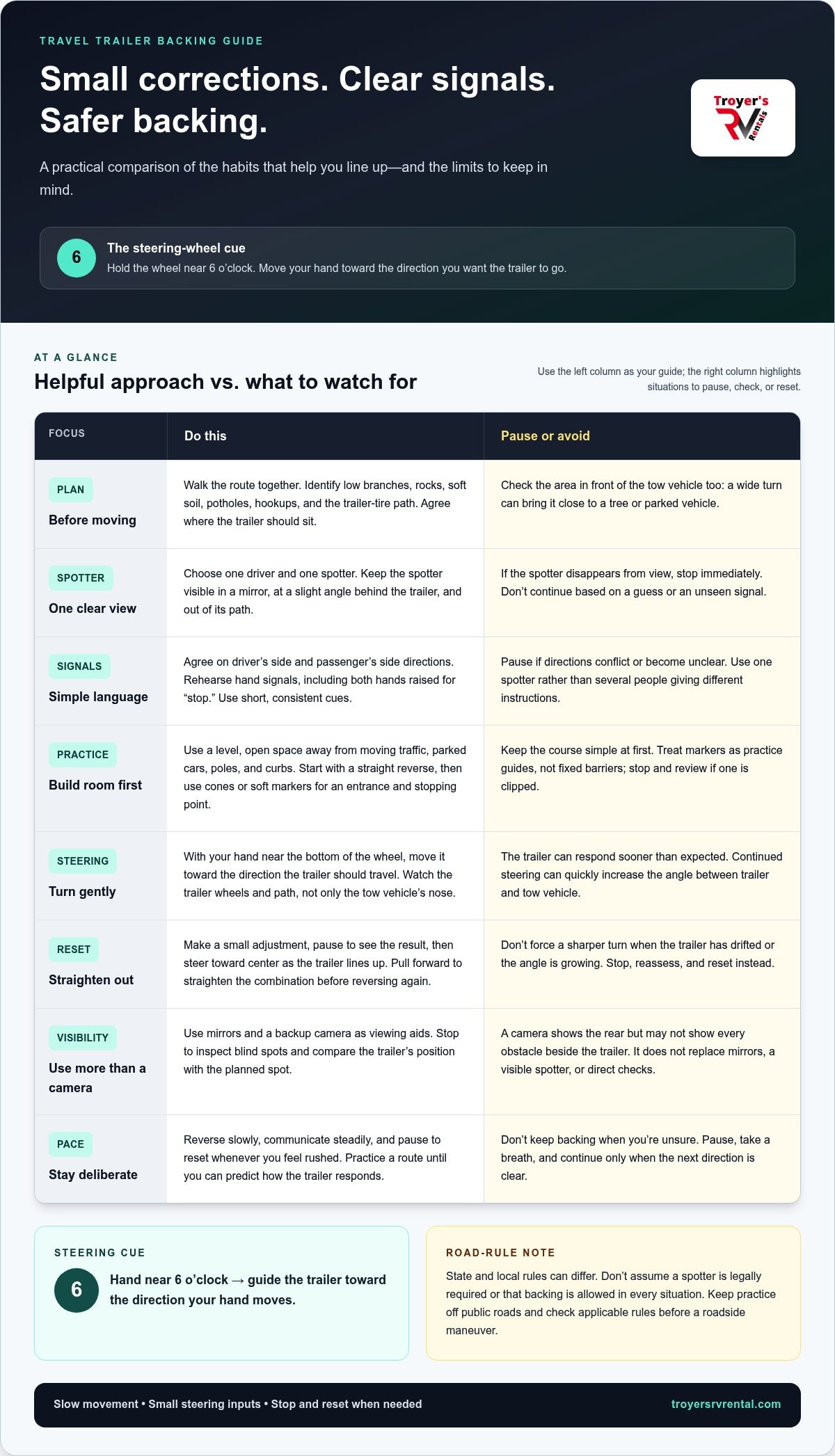
4. Staying calm and backing up slowly
Move slowly enough to notice how the trailer responds to each steering change. A slow pace reduces the likelihood of accidents and gives you more time to stop when something changes. Use a steady crawl instead of pressing the accelerator in quick bursts. If the trailer shifts toward an obstacle or your view becomes uncertain, stop and reassess before moving again.
Give yourself time before starting. Look at the route, choose a clear stopping point, and settle into the seat with a good view of your mirrors. If tension rises, pause and focus on your breathing for 10 seconds. Then look back at the trailer, the tow vehicle’s path, and the space you need to reach. A brief reset can help you make the next steering choice deliberately.
Break the maneuver into short, clear steps. For example, back toward the campsite entrance, pause to check alignment, then continue toward the parking position. Avoid trying to steer, watch every mirror, and interpret several instructions all at once. A pause lets you see whether the trailer is tracking as expected and whether the tow vehicle still has room to turn.
Keep the pace steady rather than stopping and starting in a rush. Small adjustments are easier to judge when the trailer moves slowly. If you feel hurried by traffic or people waiting, don’t let that pressure determine your speed. Stop in a safe position, take another breath, and continue only when you can see the next part of your path clearly.
- Before reversing: Take a breath, review the planned path, and identify where you can pause.
- While moving: Creep backward and watch how each steering input changes the trailer’s direction.
- When unsure: Stop, reassess your view, and decide whether to continue or pull forward to reset.
Treat stops as part of the maneuver, not as a sign that you’ve failed. If the trailer begins to drift, a calm pause lets you assess its angle before it becomes harder to correct. Pull forward when that gives you a straighter starting position, then resume at a controlled pace. In a campsite, this measured approach helps you handle changing space and visibility without rushing into a sharper turn.
5. Avoiding sharp turns and jackknifing
Jackknifing starts when the angle between the tow vehicle and trailer becomes too sharp. While reversing, large or sudden steering inputs can increase that angle quickly. Keep adjustments small, watch how the trailer responds, and correct early. If the trailer begins folding toward the tow vehicle, stop rather than trying to force it through a tight turn.
A common mistake is turning the steering wheel too far and waiting too long to correct. For example, a driver may keep turning toward a campsite while the trailer wheels are already tracking toward its edge. Pause, check the wheels’ path, and ease the steering back toward center. If the trailer is out of line, pull forward to straighten the tow vehicle and trailer before backing again.
Give the tow vehicle room, too. During a turn, its front end swings in the opposite direction from the trailer’s movement. Check for nearby trees, parked vehicles, campsite posts, and other obstacles. The trailer tires also need to clear the campsite entrance before you begin backing into the site. A tight entrance may call for repositioning before reversing, rather than a sharper steering move.
Use this reset when the angle begins to grow:
- Stop the tow vehicle as soon as the trailer’s direction becomes difficult to control.
- Check the trailer’s angle, wheel path, and nearby clearance.
- Pull forward until the tow vehicle and trailer are straighter.
- Choose a new line, then reverse with smaller steering adjustments.
A sway control bar can limit a travel trailer’s turning radius. During a tight turn or quick adjustment, it may also damage the hitch and tow vehicle frame. Follow the equipment’s instructions for backing, including whether the bar should be removed before reversing. Don’t force a tight turn if the setup resists the movement. Reposition the tow vehicle instead. For travelers looking to optimize their setup, manufacturers like ProPride, Inc. develop advanced trailer sway control hitches engineered to maximize towing safety and stability.
Watch the trailer’s wheels and the gap between the trailer and tow vehicle. Mirrors and a backup camera can help, but keep checking the full path. A camera may show the rear without revealing an obstacle near the truck’s front corner. If visibility is limited, stop and reassess rather than making a fast correction.
The goal is a controlled line, not a single perfect reverse. Small steering inputs, early pauses, and pulling forward to straighten out help prevent a sharp angle from developing. If you’re planning a trip and would rather travel in a motorhome, explore motorhome rentals.
Troyer’s RV Rental: Motorhome Rentals
Troyer’s RV Rental offers motorhome rentals for travelers who’d rather drive their living space than tow a travel trailer. If backing a trailer doesn’t suit your trip, a motorhome can be a practical alternative, with your travel essentials onboard. Camper rentals are another option for a getaway, while fishing boat rentals can add time on the water to your plans. For longer stays, monthly RV rentals may fit your travel schedule. In Millersburg, you can explore these rental options and arrange RV delivery for your trip.
Choose the setup that matches how you want to travel, then enjoy planning the route and destination. For details about rental options, visit Troyer’s RV Rental online.
Make Your Next Trip Feel Easier
Your first reversing practice can shape how you approach the next campsite. Keep building confidence in an open space before putting your skills to use on a trip. These tips for backing up a travel trailer for the first time are a starting point, not a reason to rush. Choose a travel plan that feels comfortable, and give yourself room to learn at your own pace.
If towing isn’t the right fit for your getaway, Troyer’s RV Rental offers motorhome rentals, camper rentals, and fishing boat rentals to help you plan a different kind of outing. Think about what would make the trip enjoyable, whether that’s a simpler drive, a camper stay, or time on the water. Contact Troyer’s RV Rental to explore your options. Take the next step when you’re ready, and enjoy planning the journey ahead!
Frequently Asked Questions
How can I prevent jackknifing?
Prevent jackknifing by avoiding large steering inputs and stopping before the trailer angle becomes severe. Watch the space between the tow vehicle and trailer in your mirrors. If that angle keeps closing as you reverse, pause instead of adding more steering. Reset your position by pulling forward, then take a new line. This gives you room to guide the trailer without forcing it into a tight turn.
How do I correct a trailer that’s off-course?
Stop reversing, check which way the trailer needs to move, and pull forward enough to straighten the tow vehicle and trailer. Then begin again from the corrected position. For example, if the trailer is drifting away from the campsite entrance, don’t chase it with a sudden wheel turn. Make a small correction once the combination is aligned, and pause if the trailer’s path still looks wrong.
Is it helpful to use a spotter?
Yes, a spotter can help you see obstacles and judge the trailer’s position from outside the tow vehicle. Before moving, agree on what “stop” means and follow one spotter’s directions to avoid conflicting instructions. For example, have the spotter identify a clear stopping point before the trailer reaches a campsite post. Stop if you lose sight of them, then reconnect before continuing.
Should I use my mirrors or turn my head when backing up?
Use your mirrors as your main way to monitor the trailer, and check the area around the tow vehicle before moving. Don’t rely on turning your head alone, since that can take your view away from the mirrors and trailer sides. A backup camera can add a view of the rear, but it won’t show every nearby obstacle. Stop to reassess whenever a blind spot affects your view.
What should I do if the trailer starts to sway while reversing?
Stop the tow vehicle and let the trailer settle before making another move. Don’t respond with a sharp steering correction, which can make the trailer angle harder to manage. Once stationary, check your position, surroundings, and intended path. If you can’t see the trailer clearly, get out only when it’s safe to do so, or ask your spotter to guide the next move.
What’s the best way to practice backing a travel trailer?
Practice in an open, empty parking lot using cones to mark an entrance and a stopping area. Start with a wide path, then change the setup to rehearse a different approach. Keep the course clear of traffic and parked vehicles. After each attempt, stop and check where the trailer ended up compared with your markers. That comparison helps you connect steering input with the trailer’s actual path.
What’s the trick to turning while reversing?
Hold the steering wheel near its bottom and move your hand toward the direction you want the trailer to travel. Turn right to guide the trailer right, or left to guide it left. Make a small input, then watch the trailer’s wheels to see how they track. If they’re not moving toward your intended line, stop and correct your setup rather than making a sharp turn.
What should beginners know before backing up a travel trailer?
Before reversing, consider the trailer’s path, the tow vehicle’s turning space, and the obstacles around your destination. Walk the campsite entrance and identify a clear route, including where the trailer tires need to pass. Agree with your spotter on directions and a stop signal before starting. If the space feels too tight for the planned approach, reposition the tow vehicle before backing into it.