
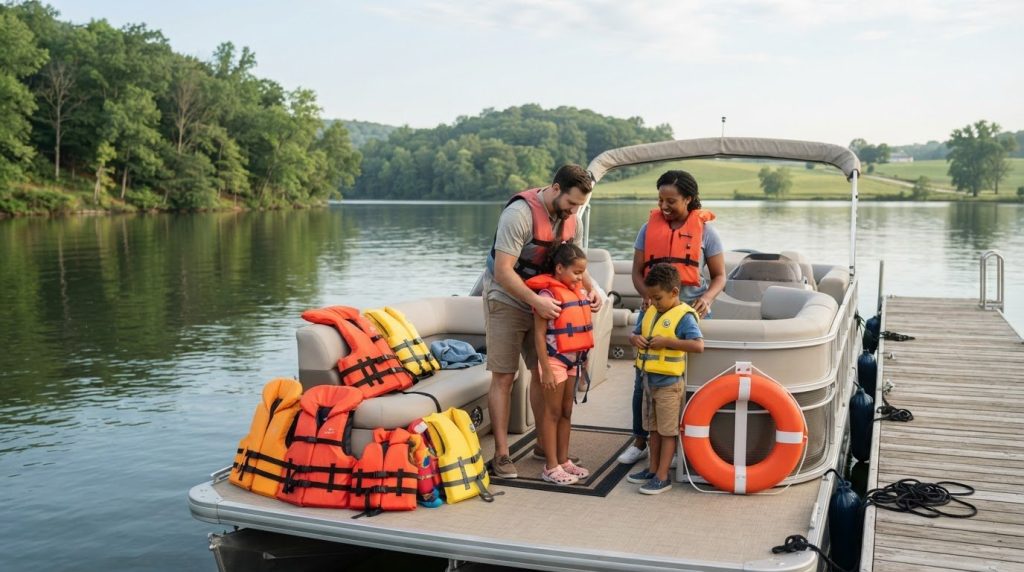
A life jacket that doesn’t fit or can’t be reached isn’t ready when someone needs it. Under the life jacket rules for boat rentals in Ohio, a vessel must carry one U.S. Coast Guard-approved wearable PFD in the right size for each person aboard. For boats 16 feet or longer, except canoes and kayaks, the Ohio Department of Natural Resources says a throwable flotation device is also required.
It’s easy to assume that having enough jackets on board is all that matters. Approval, condition, fit, and accessibility count too, and some requirements depend on the boat and who’s aboard.
This guide explains PFD requirements for rental vessels, the features required life jackets need, and how to choose a suitable fit. You’ll also learn where to stow jackets, how flotation types differ, and when a throwable device is required, so you can prepare for your Ohio outing.
Key Takeaways
- Match the number and type of PFDs to the vessel and everyone aboard. For boats 16 feet or longer, except canoes and kayaks, the Ohio Department of Natural Resources requires a throwable flotation device.
- Choose a U.S. Coast Guard-approved wearable PFD in the right size, and pay attention to Ohio’s rules for children aboard smaller vessels.
- Keep wearable life jackets readily accessible and throwable devices immediately available, not sealed away or buried under gear.
- Check the approval label, fit, condition, and any use limits before deciding a PFD is suitable for your outing.
- Learn how wearable and throwable flotation types differ, including when an inflatable PFD can count toward the required equipment.
PFD equipment requirements for vessels rented for hire
Ohio rental vessels must carry required safety equipment, including wearable PFDs for everyone aboard. Boater education rules also apply to some renters operating motorized boats.
PFD equipment on rental vessels
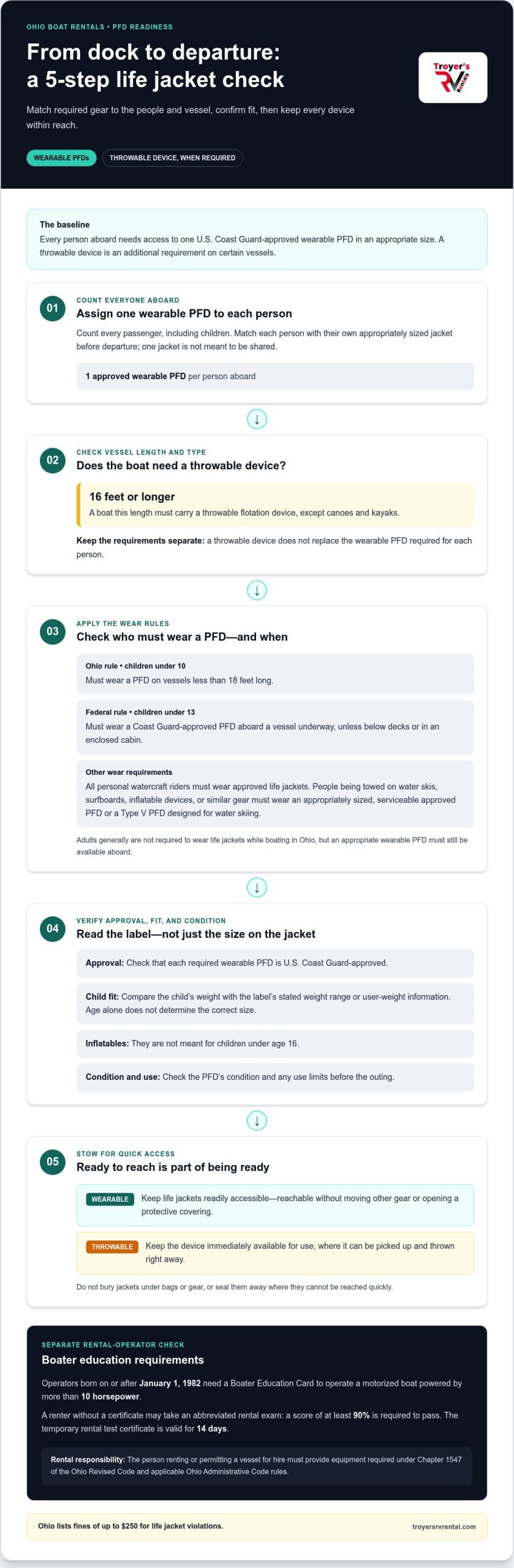
A PFD equipment requirement is the minimum flotation gear a vessel must carry for its trip. In Ohio, a vessel must have one U.S. Coast Guard-approved wearable PFD in an appropriate size for each person aboard. The person renting or permitting a vessel for hire must provide equipment required under Chapter 1547 of the Ohio Revised Code and rules adopted under the Ohio Administrative Code. Count every passenger before departure, including children.
Life jackets for each person aboard
A wearable PFD is a life jacket designed to be worn. Match the number of jackets to the number of people aboard, and choose an appropriate size for each person. A loose adult jacket is not a suitable substitute for a child-sized one. Before leaving the dock, make sure each passenger has a wearable PFD available rather than relying on one jacket to be shared.
Throwable PFD requirements by vessel length
A throwable PFD is a flotation device that can be thrown to someone in the water. According to the Ohio Department of Natural Resources, a boat 16 feet or longer, except a canoe or kayak, must carry a throwable flotation device. Keep this requirement distinct from wearable PFDs: a throwable device does not replace the wearable jacket required for each person aboard. Check the vessel’s length and type when identifying required gear.
Passenger life jacket wear requirements
A wear requirement identifies when someone must have a PFD on, not merely aboard. According to the Ohio Department of Natural Resources, children under age 10 must wear a PFD on vessels less than 18 feet long. Federal rules also require children under 13 to wear a Coast Guard-approved PFD aboard a vessel underway, unless they are below decks or in an enclosed cabin. All personal watercraft riders must wear approved life jackets.
Adults generally aren’t required to wear life jackets while boating in Ohio, but they still need an appropriate wearable PFD available aboard. Passengers being towed on water skis, surfboards, inflatable devices, or similar gear must wear an appropriately sized, serviceable approved PFD or a Type V PFD designed for water skiing. Ohio lists fines of up to $250 for life jacket violations.
Boater education requirements for renters
Boater education rules set training requirements for certain people operating motorized boats. In Ohio, operators born on or after January 1st, 1982 must hold a Boater Education Card to operate a motorized boat powered by more than 10 horsepower. A renter without a certificate may use an abbreviated rental exam as an alternative, and must score at least 90% to pass. The temporary rental test certificate is valid for 14 days.
What is required of every PFD in Ohio?
Whether a child must wear a PFD depends on the vessel, whether it’s underway, and the child’s fit. Ohio’s age and vessel-length rule and the federal underway rule have different thresholds.
Age-based child life jacket rules
An age-based rule makes a child wear a PFD when the child and vessel meet its conditions. According to the Ohio Department of Natural Resources, children under age 10 must wear a PFD on vessels less than 18 feet long. This Ohio requirement combines the child’s age with the watercraft’s length, so identify both before departure.
Federal rules cover a separate situation. According to the U.S. Coast Guard, children under 13 must wear a Coast Guard-approved PFD aboard a vessel underway, unless they are below decks or in an enclosed cabin. The underway condition matters: a vessel moving on the water is not the same circumstance as someone below decks.
Consider both rules when planning a trip. For example, a child covered by Ohio’s age rule must wear a PFD on a vessel below the specified length threshold. A child covered by the federal rule must wear one while the vessel is underway, unless an exception applies. Don’t treat one threshold as a substitute for the other.
Children’s life jacket fit
A child’s PFD fits when its stated weight range matches the child wearing it. Choose a jacket based on the child’s weight and the user-weight information or approval statement on the label. Age alone doesn’t determine the right size, so read the label before boarding.
These markings are examples, not interchangeable sizes. Compare the child’s weight with the stated range, then make sure the jacket is wearable and appropriate for that child.
Inflatable PFDs aren’t meant for children under age 16. For a younger child, choose a wearable PFD designed for the child’s weight rather than an inflatable model. Before the vessel leaves, match each child to their own correctly sized jacket and have them wear it whenever a rule requires it.
Life jacket accessibility and stowage
A readily accessible PFD can be reached quickly without moving other gear or opening a protective covering. In Ohio, wearable life jackets must be readily accessible, while throwable devices must be immediately available for use. Keep both standards in mind when arranging the vessel. A jacket buried under bags or sealed in a plastic bag isn’t ready to grab when needed.
Locate every wearable PFD before the vessel leaves. Put jackets where passengers can reach them, rather than stacking them beneath food, towels, or fishing equipment. In a canoe, keep wearable PFDs accessible in the available space, not sealed inside a dry bag. The same principle applies to larger boats: passengers should be able to reach a jacket without clearing a pile of gear.
Stow throwable devices where they can be picked up and thrown immediately. Don’t bury a ring buoy or other throwable flotation device under equipment or leave it inside a closed compartment. If tackle boxes block access, rearrange the gear before departure. Accessible stowage means the device is ready to use without delay.
Condition matters as much as location. Ohio PFDs must be in good, serviceable condition, so inspect each jacket for damage before use. A damaged or unserviceable PFD does not meet the requirements and must be replaced. Check seams, straps, closures, and flotation material for visible wear. Set aside any jacket that can’t be used as intended.
Inflatable PFDs need an additional readiness check. An inflatable life jacket must have a full cylinder and green status indicators to be serviceable and count toward the requirement to carry life jackets. Check the indicator before the trip, and don’t count the PFD as ready if the status isn’t green. Keep it accessible rather than packed away with spare equipment.
Before departure, identify the wearable jackets, confirm they’re accessible and serviceable, then locate the throwable device. Make sure no plastic bag, protective covering, or loose gear blocks access. This quick review can reveal stowage problems while you’re still at the dock.
Coast Guard approval and proper fit
A Coast Guard-approved PFD bears approval information on its label. Ohio’s wearable PFD requirements call for U.S. Coast Guard-approved jackets, so look for the approval statement rather than judging by appearance alone. The label identifies who the jacket is intended for and any conditions on its use. Read it before assigning a PFD to a passenger.
Proper fit means choosing a wearable PFD suited to the person who will use it. For a child, use the weight information or approval statement on the label to select the right jacket. A marking such as “30 to 50 pounds” describes a weight range, not an age group. Match the child’s weight to the label, rather than choosing a larger jacket to allow room to grow.
Check that the selected jacket can be worn as intended. Adjust its straps and closures, then make sure it stays in place as the wearer moves. A PFD that slips, rides up, or is too large may not fit properly. Check every passenger’s fit, especially if a child has grown since the last trip or is using a different jacket.
A Type V PFD is a special-use life jacket with conditions printed on its approval label. In Ohio, it may substitute for a wearable PFD only when the label permits substitution and it’s used according to the label and owner’s manual. Check both before relying on it. A Type V label may limit how the PFD can be used, so don’t assume every model replaces a standard wearable jacket.
Personal watercraft riders have a clear requirement: everyone riding a PWC in Ohio must wear a U.S. Coast Guard-approved life jacket at all times. Keep it on while riding, not merely stowed within reach. A proper fit matters during movement, since a loose jacket can shift while the rider operates or rides the craft.
People being towed on water skis, surfboards, inflatable devices, or similar equipment must wear an appropriately sized, serviceable U.S. Coast Guard-approved wearable PFD. A Type V PFD designed for water skiing is also allowed. Choose according to the activity and the label. For example, don’t use a general-purpose Type V model for water skiing unless it’s specifically designed for that activity.
On Ohio State Park lakes, each passenger must have a U.S. Coast Guard-approved life jacket. Before departure, check the label, match each wearable PFD to its intended user, and follow any Type V instructions. These steps help confirm the jacket meets the stated requirements and suits the person or activity.
Life jacket types and flotation
A wearable PFD is flotation equipment designed to be worn by one person. Ohio’s requirements for boats more than 16 feet long allow wearable life jackets classified as Type I, II, III, or V. These labels identify recognized categories, but the label and manual still matter. Read both before relying on a specific jacket for a passenger or activity.
A throwable PFD is flotation equipment designed to be tossed to someone in the water. Both are examples of throwable devices, not wearable jackets. Keep the distinction clear when counting equipment for a vessel.
Type codes remain useful when reading Ohio’s listed requirements, but federal terminology has changed. The U.S. Type labels and terminology can vary, so check the jacket’s label and instructions. Labels may use newer information, including performance-level wording. Check the approval label and applicable instructions rather than assuming a familiar type name tells the whole story.
Level 70 describes a life jacket providing approximately 15 pounds of flotation. That figure helps explain the label, but it doesn’t replace checking whether the PFD is approved and suitable for its intended use. Compare the jacket’s marked information with the people and activity aboard. A flotation rating alone doesn’t establish that a particular model meets every requirement.
An inflatable PFD is a wearable life jacket that uses inflation to provide buoyancy. Inflatable life jackets are authorized on recreational boats only for people at least 16 years old. For younger passengers, select a different suitable wearable PFD. Before counting an inflatable jacket as serviceable required equipment, confirm that its cylinder is full and its status indicators are green.
Use each label to guide a practical equipment check. First, identify whether the item is wearable or throwable. Next, read its approval and use information. Then match the PFD to the passenger or purpose. For an inflatable model, check the cylinder and green indicators. A Type IV cushion is throwable equipment, not a passenger’s wearable jacket.
Ohio’s boat-length requirements and PFD labels work together. A throwable cushion cannot replace required wearable equipment, and a flotation level alone doesn’t establish how a jacket may be used. Keep each item’s role clear, and follow its approval label and owner’s manual before setting out.
Troyer’s RV Rental: Motorhome Rentals
Troyer’s RV Rental offers motorhome rentals for road trips and fishing boat rentals for outings on the water. Choose the rental that suits your plans, and keep Ohio’s PFD rules in mind for any boating. A motorhome or camper can support a land-based getaway; a fishing boat is the option for getting out on the water.
Once you’ve chosen the right rental, use this guide’s PFD checklist: confirm the required wearable jackets, proper fit, accessible stowage, and any throwable device requirement. Visit troyersrvrental.com to explore rental options or get in touch about your trip.
Make your next outing a prepared one
Make the life jacket rules for boat rentals in Ohio part of your pre-trip routine. Before heading out, decide who will check the gear and make sure every passenger knows where their equipment is kept. A quick conversation helps everyone prepare and focus on enjoying the day.
For the rest of your getaway, Troyer’s RV Rental offers motorhome rentals, camper rentals, and fishing boat rentals. Choose the trip that suits your plans, and bring the same practical preparation to your time on the water.
Ready to plan your outing? Contact Troyer’s RV Rental to explore your options. Here’s to a smooth start and a memorable Ohio adventure!
Frequently Asked Questions
What are Ohio’s life jacket requirements for recreational boats?
Ohio recreational boats must carry an appropriately sized, U.S. Coast Guard-approved wearable PFD for each person aboard. The life jacket rules for boat rentals in Ohio also depend on vessel length and type. For example, boats 16 feet or longer, except canoes and kayaks, must carry a throwable flotation device. Identify the vessel and passenger count before preparing its safety equipment.
How many life jackets must a boat carry in Ohio?
Carry one appropriately sized wearable PFD for every person aboard. Count each passenger, including children, and match each person with a suitable jacket. A separate throwable device is required on boats 16 feet or longer, except canoes and kayaks. It doesn’t replace anyone’s wearable PFD. The vessel’s length and type determine whether this additional equipment is required.
What life jacket rules apply to children on boats in Ohio?
Ohio’s child requirement depends on age and vessel length. Federal rules also require children under 13 to wear a Coast Guard-approved PFD aboard a vessel underway, unless they’re below decks or in an enclosed cabin, according to the U.S. Coast Guard. Choose a child’s jacket by weight.
Do Ohio boat rentals have to provide life jackets for every passenger?
Yes. In Ohio, a person who rents or permits the use of a vessel for hire must provide equipment required under Chapter 1547 of the Ohio Revised Code and applicable Ohio Administrative Code rules. The life jacket rules for boat rentals in Ohio therefore call for suitable wearable PFDs for everyone aboard. Before departure, count passengers and match each one with a jacket, rather than relying on shared or spare gear.
Are life jackets required while boating on Lake Erie or Ohio rivers?
Ohio’s statewide PFD requirements apply while boating on Lake Erie and Ohio rivers. Which requirements apply depends on the vessel’s length and type, passenger ages, and activities such as towing. Identify the boat and who will be aboard before setting out. PWC riders must wear a PFD, and people being towed have specific wear requirements, so account for the activity when planning your trip.
What types and sizes of life jackets are approved for Ohio boating?
Choose a U.S. Coast Guard-approved wearable PFD and use its label to match it to the wearer and intended use. For boats more than 16 feet long, Ohio’s listed wearable-jacket types are Type I, II, III, or V. Select a child’s jacket according to the weight information on its label. A Type V PFD can substitute for a wearable jacket only when its label permits that use and its instructions are followed.
How can renters check that a rental boat’s life jackets fit and are in good condition?
Read each jacket’s label and compare its user-weight information with the intended wearer. Check for damage or signs that a PFD is unserviceable, and don’t count a damaged jacket as required equipment. For an inflatable model, confirm that the cylinder is full and the status indicators are green. Before leaving the dock, make sure the jackets are accessible and the quantity matches the number of people aboard.