

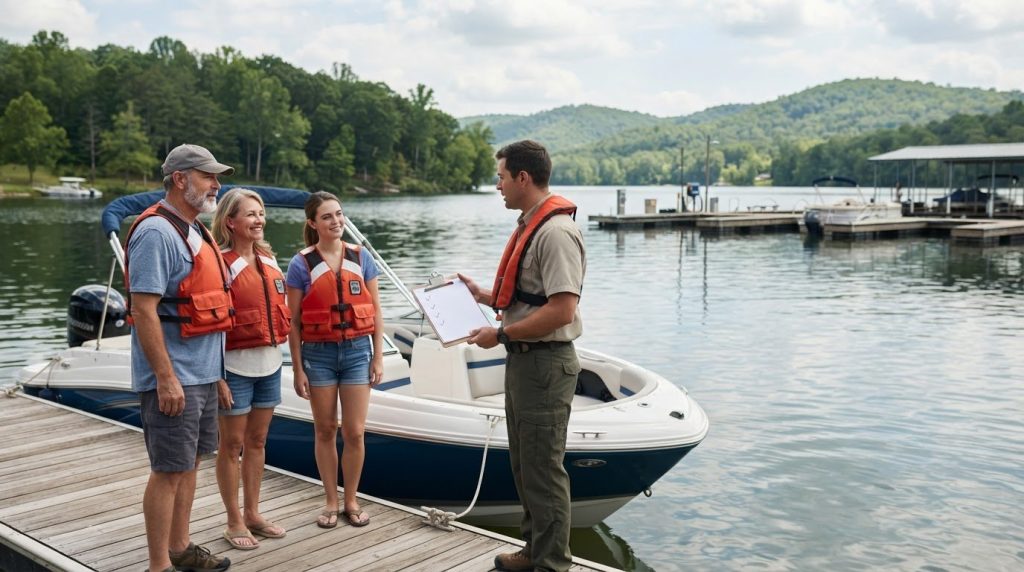
The answer to whether you need a boating license to rent a boat in Ohio is straightforward: Ohio doesn’t issue a traditional driver-style boating license. For a motorized rental with an engine over 10 horsepower, a person born on or after January 1, 1982, must meet the boating education requirement. A rental business may offer an abbreviated exam, and you must score at least 90 percent to qualify through that option.
It’s easy to assume that renting a boat means you can take the keys and go. In Ohio, requirements depend on the boat’s power, the operator’s birth date and age, and whether it’s a personal watercraft. This guide explains when you need a safety course or certificate, which age limits apply, and how a rental exam works, so you know what to prepare before heading out on the water.
Key Takeaways
- Ohio doesn’t issue a traditional recreational boating license. For many motorized boats, the key requirement is boating education, not a driver-style license.
- The education rule depends on the boat’s engine power and the operator’s birth date, so identify both before planning a rental.
- A rental business may offer an abbreviated boating exam; passing requires a score of at least 90 percent, and the exam applies to that rental period.
- Age rules differ for motorboats and personal watercraft. Ohio Laws and Administrative Rules allow people aged 12-15 to operate a personal watercraft only with a supervisor aged 18 or older on board.
- Use the article’s boat-type and age breakdown to see which education requirements apply to your plans before you head out.
Boating certificate requirement for renting a motorized boat
Do Ohio boat rental companies require an operator permit or safety certificate? Ohio doesn’t issue a traditional driver-style recreational boating license. For a boat powered by more than 10 horsepower, education rules may require an operator to hold a Boater Education Certificate or meet the rental exam option.
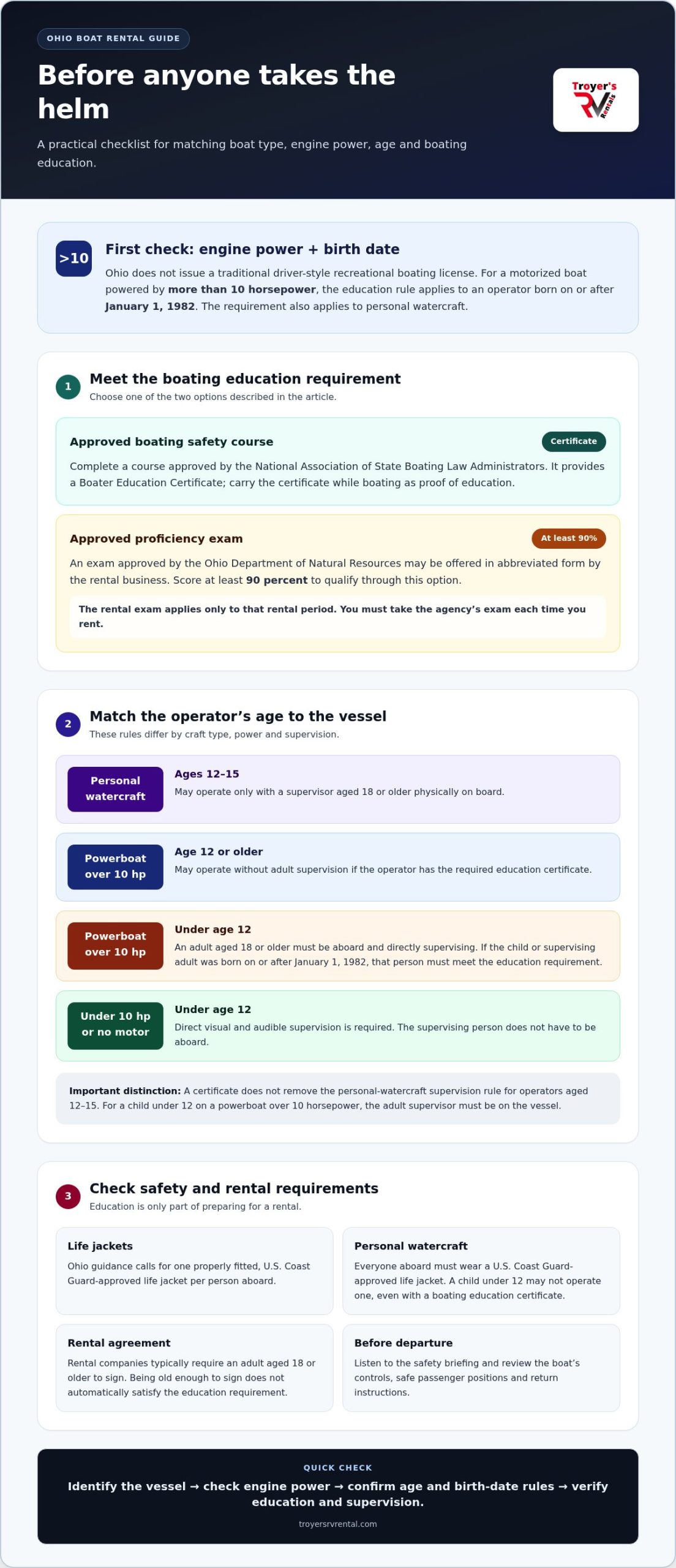
The rule for a motorized rental depends on the engine and the operator’s birth date. A rental company cannot rent a boat powered by more than 10 horsepower to someone born on or after January 1, 1982, unless that person meets Ohio’s boating education requirement. This requirement also applies to personal watercraft.
There are two ways to meet the education requirement:
- Complete an approved boating safety course. The course must be approved by the National Association of State Boating Law Administrators.
- Take a proficiency exam approved by the Ohio Department of Natural Resources. A rental business may administer an abbreviated exam; the renter must score at least 90 percent.
A rental exam is not a permanent certificate. It applies only for the rental period, and renters who choose this option must take the agency’s exam each time they rent. An approved course, by contrast, provides a Boater Education Certificate. Carry the certificate while boating, as Ohio requires it as proof of education.
Age matters separately from certification. Ohio Laws and Administrative Rules allow people aged 12-15 to operate a personal watercraft only when a supervisor aged 18 or older is also on board. A child under 12 may not operate a personal watercraft, even with a boating education certificate. Everyone aboard a personal watercraft must wear a U.S. Coast Guard-approved life jacket.
Rental eligibility also involves the agreement. Ohio rental companies typically require an adult aged 18 or older to sign it. That signing requirement is distinct from the state’s education rule: being old enough to sign does not automatically satisfy the certificate requirement for a higher-powered boat.
Before departure, listen to the rental safety briefing and make sure everyone has a properly fitted, U.S. Coast Guard-approved life jacket. Ohio guidance calls for one life jacket per person aboard. Use the briefing to review the boat’s controls, safe passenger positions, and instructions for returning the vessel.
For an Ohio boater, the practical distinction is clear: a traditional license isn’t the credential. For a boat over 10 horsepower, check whether the operator’s birth date triggers the education rule, then use an approved course or the rental exam option. Personal watercraft add specific age and life-jacket rules.
Minimum ages for operating motorized vessels
Ohio’s operator-age rules depend on vessel type, engine power, and supervision. Powerboats and personal watercraft do not follow identical rules, so an operator’s age alone does not determine whether they may take the controls. First identify the type of craft, then consider its engine power and the education requirements.
Ohio Laws and Administrative Rules allow people aged 12-15 to operate a personal watercraft when a supervisor who is at least 18 years old is also on board. That age range applies specifically to personal watercraft, not every motorized vessel. The supervising adult must be physically aboard, not simply nearby on shore or in another boat.
For a powerboat other than a personal watercraft, operators aged 12 or older may operate a vessel powered by more than 10 horsepower without adult supervision if they have the required education certificate. This rule makes the craft type important: a certificate does not remove the personal-watercraft supervision rule for someone aged 12-15.
A child under 12 faces a different standard on a powerboat over 10 horsepower. They may operate only with an adult aged 18 or older aboard and directly supervising. If the child or supervising adult was born on or after January 1, 1982, that person must meet the education requirement. An adult’s presence alone does not replace a required certificate.
For a motorized vessel under 10 horsepower, or a vessel without a motor, a child under 12 must remain under the direct visual and audible supervision of a supervising person. That person does not have to be aboard. This differs from the over-10-horsepower rule, which requires the supervisor to be on the vessel. “Direct” supervision means the adult can see and hear the child, rather than relying only on occasional updates.
Use this quick comparison when deciding who can operate:
- Personal watercraft, ages 12-15: An adult supervisor aged 18 or older must be on board.
- Powerboat over 10 horsepower, age 12 or older: An operator with the required education certificate may operate without adult supervision.
- Powerboat over 10 horsepower, under age 12: An adult aged 18 or older must be aboard and directly supervising.
- Vessel under 10 horsepower or without a motor, under age 12: Direct visual and audible supervision is required, but the supervisor need not be aboard.
Before anyone takes the helm, match the operator’s age to the exact vessel type and power. Then consider the certificate rule, including the January 1, 1982 birth-date threshold. The Ohio Department of Natural Resources, Division of Parks & Watercraft, enforces state boating laws on Ohio waters. An approved boating safety course and a boater education card can matter even when an adult is supervising.
Are Ohio boating education requirements based on age or birth date?
Ohio’s boating education rule uses a birth-date cutoff, while separate age rules determine who may operate particular vessels. According to Ohio Laws and Administrative Rules, a person born on or after January 1, 1982, must complete a boating course or proficiency exam to operate a boat powered by more than 10 horsepower. The threshold applies to personal watercraft operators as well as motorboat operators.
This means two people of the same age could face different education requirements if their birthdays fall on opposite sides of the cutoff. For example, an operator born just before January 1, 1982, isn’t covered by this birth-date education rule. Someone born on January 1, 1982, is covered when operating a boat over 10 horsepower. Both operators still need to follow other rules, including vessel-specific age restrictions.
The proof requirement also has a defined time limit. According to Ohio Laws and Administrative Rules, anyone born on or after January 1, 1982, operating a vessel powered by more than 10 horsepower must produce proof of an approved boating course or proficiency test no later than 72 hours after being stopped by law enforcement. The 72-hour period concerns producing proof after a stop. It doesn’t change which birth dates trigger the education requirement.
Ohio provides more than one way to meet the education requirement. Operators can complete an approved boating safety course or pass a proficiency exam approved by the Ohio Department of Natural Resources. A rental company’s abbreviated exam is a separate option that applies only during the rental period. It does not override the birth-date rule for future trips or replace a lasting course credential.
For example, a renter born after the cutoff who plans to operate a higher-powered boat must meet the education requirement, whether the trip is recreational or the boat is rented. Completing an approved course before the trip provides proof of course completion. A rental exam, instead, applies only to that rental agreement. Operators should have their proof available while boating.
Age and birth date answer different questions. The cutoff determines who must meet the boating education requirement for boats over 10 horsepower. Age rules determine whether a person may operate a specific craft, and whether an adult must supervise. A certificate doesn’t cancel a personal-watercraft age restriction or remove supervision requirements for a child. Review both the operator’s birth date and age, then identify the vessel and engine power before deciding which rules apply.
There is no minimum age for taking Ohio’s online boating course. However, completing the course does not automatically make a student eligible to operate every vessel. A young operator, for instance, may complete the course and still need to follow separate age and supervision rules for personal watercraft. Check education proof and operator eligibility separately before the trip.
Can renters operate a boat in Ohio after completing a rental safety course?
Yes. Ohio allows a rental business to administer an abbreviated boating exam for qualifying renters. For a boat powered by more than 10 horsepower, an operator born on or after January 1, 1982, must meet the education requirement. Passing the rental exam with at least 90 percent can satisfy that requirement for the rental period.
The rental exam is a limited-use option, not a permanent substitute for a Boater Education Certificate. It expires when the rental agreement ends. If you rent again and choose the rental agency’s exam option, you must take that agency’s exam again. For proof that applies to future boating, complete an approved safety course or pass an approved proficiency exam.
Keep the difference clear before choosing a route:
- Rental exam: The rental business administers an abbreviated exam, and the renter must score at least 90 percent. It applies only for that rental agreement.
- Boating safety course: Completing an approved course provides education proof that can be used beyond one rental period.
- Proficiency exam: An exam approved by the Ohio Department of Natural Resources can meet the education requirement.
The rental exam option doesn’t remove other eligibility rules. The operator still needs to meet the applicable age restrictions for the boat type. For example, an operator’s passing score does not let a child under 12 operate a personal watercraft. Personal watercraft operators aged 12-15 need an onboard supervisor aged 18 or older.
Before taking a rental exam, identify the boat’s engine power and the operator’s birth date. Those details determine whether Ohio’s boating education rule applies. Then ask the rental staff for the exam instructions and complete the questions before taking the vessel out. A score below 90 percent does not meet the rental exam threshold, so the renter needs another qualifying route before operating.
After passing, follow the rental agreement’s dates and keep any education proof accessible during the trip. The rental exam is tied to that agreement, not to later outings or rentals. A permanent certificate is different: it documents completed boating education and means you do not have to repeat the rental agency’s abbreviated exam each time.
Choose the option that fits your plans. For a one-time rental, the rental exam may be practical. If you plan to operate boats on future trips, an approved course can provide lasting proof of education. Either way, an exam or course addresses education only. Age limits, supervision rules, life jacket requirements, and rental terms still apply on Ohio waters.
What types of boats can be rented in Ohio without a boating license?
Ohio doesn’t issue a traditional driver-style recreational boating license. For rentals, the key distinction is engine power: the state’s education requirement applies to boats powered by more than 10 horsepower. A boat with a motor of 10 horsepower or less doesn’t cross that threshold. That answers the education question, but it doesn’t remove age rules or rental terms.
Nonmotorized vessels, such as boats without an engine, also don’t fall under the over-10-horsepower education rule. A small motorized boat at or below 10 horsepower is another option to consider. Still, the boat’s power alone doesn’t settle every rental condition. The operator’s age, the vessel type, and the rental agreement all matter before anyone takes the helm.
Use this distinction to sort possible rentals:
- Vessels without a motor: They don’t meet the engine-power threshold for the boating education requirement.
- Motorized boats at 10 horsepower or less: They’re below the threshold that triggers that requirement.
- Motorized boats over 10 horsepower: Operators born on or after January 1, 1982, must meet Ohio’s education requirement.
- Personal watercraft: These have separate age restrictions, regardless of the general motorboat distinction.
Don’t treat a personal watercraft as simply another small rental boat. In Ohio, a child under 12 may not operate one, even with a boating education certificate. Operators aged 12-15 need a supervisor aged 18 or older aboard. Everyone on a personal watercraft must wear a U.S. Coast Guard-approved life jacket.
Engine power is therefore the first filter, not the only one. For example, an operator born after the education-rule cutoff choosing a boat over 10 horsepower must meet the requirement. Choosing a boat at or below 10 horsepower avoids that particular threshold, but a renter still needs to follow applicable age restrictions and the rental agreement. Ohio rental companies typically require an adult aged 18 or older to sign the agreement.
Before choosing, identify whether the vessel has a motor, then find its horsepower and classify its type. Next, match the operator’s age and birth date to the relevant rule. For boats over 10 horsepower, an approved course, proficiency exam, or qualifying rental exam may satisfy the education requirement. A rental exam requires a score of at least 90 percent and applies only to that rental agreement.
For a fishing outing, browse fishing boat rental options and compare the planned trip with Ohio’s engine-power and operator rules. Whatever vessel you rent, carry the required education proof when applicable and have one properly fitted, U.S. Coast Guard-approved life jacket for each person aboard.
Troyer’s RV Rental: Motorhome Rentals
Troyer’s RV Rental offers motorhome rentals for travelers planning an Ohio getaway beyond the water, as well as fishing boat rentals for time on the water. If your trip includes both boating and exploring by road, choose the rental options that fit your plans and remember to follow Ohio’s operator-age and boating education rules. Renting a boat does not replace the need to meet applicable state requirements. Explore motorhome rentals or fishing boat rentals from Troyer’s RV Rental online.
Make Your Ohio Trip Your Own
Plan a boating trip that works for your group. If you’re still wondering whether you need a boating license to rent a boat in Ohio, use this guide to prepare before setting out. Then consider how you’d like to spend the rest of your time, on the water, along the road, or both. For broader outdoor inspiration and destination guides when mapping out your itinerary, travel resources like Searchland can provide great ideas. A little planning can help you choose a trip everyone feels comfortable joining.
Troyer’s RV Rental offers Fishing Boat Rentals for time on the water, plus Motorhome Rentals and Camper Rentals for exploring beyond the dock. Choose the kind of getaway that suits your plans, and take the next step when you’re ready. Contact Troyer’s RV Rental to get started. Here’s to a great Ohio trip and good memories along the way!
Frequently Asked Questions
Who needs an Ohio Boater Education Card?
People born on or after January 1, 1982, need to meet Ohio’s education requirement to operate a boat powered by more than 10 horsepower. They can complete an approved boating safety course or pass an approved proficiency exam. A rental company’s abbreviated exam can satisfy the requirement for that rental period, but it isn’t a lasting education card. Keep your certificate available while boating as proof of completed education.
Is anyone exempt from obtaining the Ohio boating license?
Ohio doesn’t issue a traditional driver-style recreational boating license, so there’s no such license to obtain. The birth-date education requirement for boats over 10 horsepower applies to people born on or after January 1, 1982. People born earlier aren’t covered by that specific requirement. Separate age restrictions still apply, especially for personal watercraft, and rental agreements may set additional conditions for the person signing.
Does Ohio require a boating license to rent a boat?
No traditional boating license is required because Ohio doesn’t issue one. If you’re asking whether you need a boating license to rent a boat in Ohio, focus instead on the boat’s engine power and the operator’s birth date. For a boat over 10 horsepower, a rental business may offer an abbreviated exam. Passing requires at least 90 percent, and the exam is valid only during that rental agreement.
What Ohio boater education requirements apply to rental boat operators?
For a boat powered by more than 10 horsepower, operators born on or after January 1, 1982, must meet the education requirement. An approved course or proficiency exam can qualify; a rental exam is another option for that agreement. A course used for the requirement must be approved by the National Association of State Boating Law Administrators. Carry your certificate as proof while boating, rather than relying on memory of course completion.
What identification, age, and experience requirements do Ohio boat rentals have?
Ohio rental companies typically require an adult aged 18 or older to sign the agreement. Visitors operating a boat should carry their original out-of-state boater education card and photo ID. For a Millersburg-area outing, plan the operator and paperwork before departure. Ohio’s statewide rules described here focus on age, birth date, engine power, and education; meeting those rules doesn’t itself establish a renter’s practical boat-handling experience.