
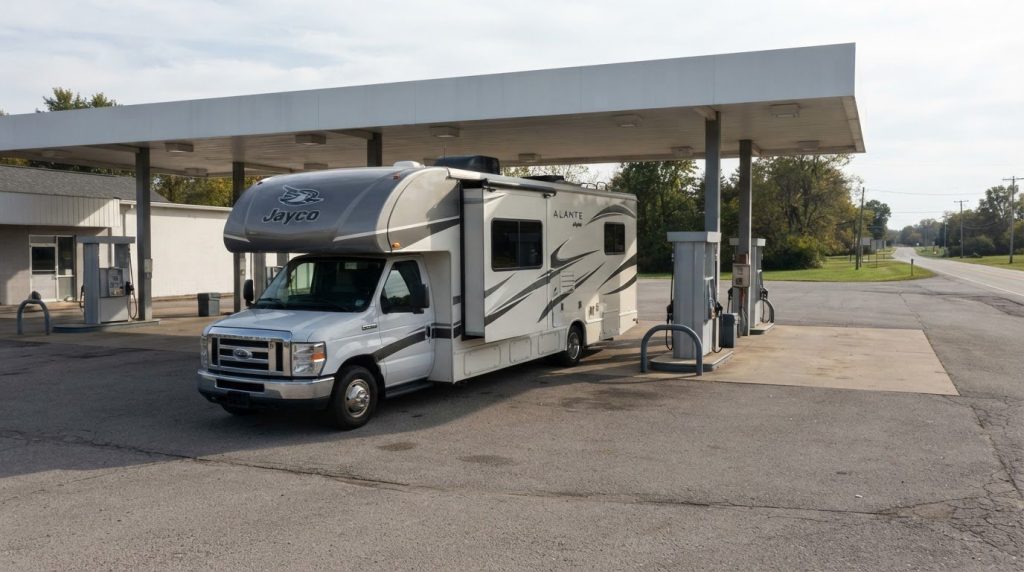
A station can look easy to enter and still leave you stuck on the way out. To find RV-friendly gas stations, look for high canopies, open space around the pumps, and a route through the lot that gives you room to turn and exit. Start planning when your tank is about half full, so you have time to compare options instead of settling for a tight stop.
Fueling up shouldn’t turn a travel day into a stressful maneuvering exercise. The right station depends on your RV’s full length, including any towed vehicle, and on the clearance and layout at the pump. This guide explains how to assess those details with a map’s satellite view, choose stops that suit your setup, spot truck-stop pump lanes, and get practical local recommendations. A little planning can make it easier to pull in, fuel up, and get back on the road with confidence.
Key Takeaways
- Judge a station by the full path through the lot, not just whether you can pull up to a pump.
- Use your complete travel setup, including anything you’re towing, to decide which stops are practical.
- Look for truck stops with pump lanes that make it easier to fuel without awkward turns.
- Ask campground staff and local RVers which nearby fuel stops suit a vehicle like yours.
1. Checking station canopies, pumps, and maneuvering space
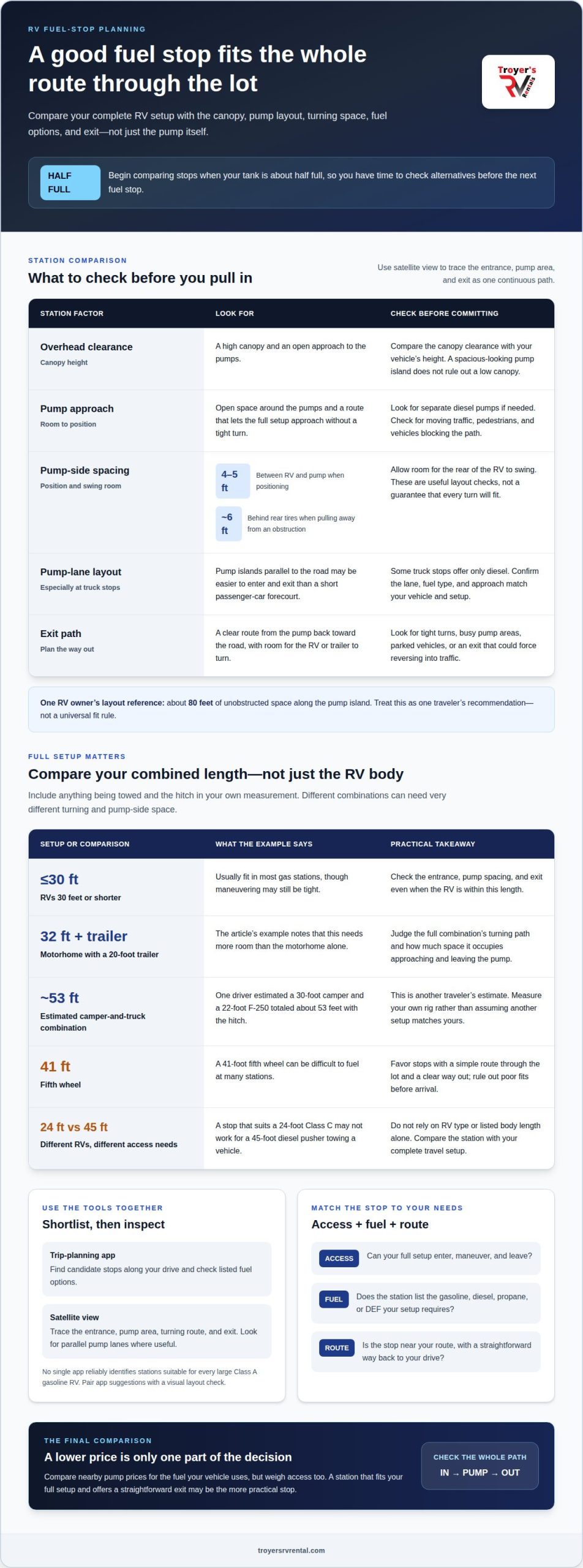
Start with overhead clearance. A low canopy can block an RV even when the pump island looks spacious, so compare the clearance with your vehicle’s height. Look for stations with high canopies, separate diesel pumps, and open approaches. In a map app, switch to satellite view and trace the entrance, pump area, and exit before committing to the stop.
Then check the space around the pumps. Leave four or five feet between the RV and a pump when positioning, allowing room for the rear to swing. Look for about six feet behind the rear tires when pulling away from an obstruction. One RV owner recommends 80 feet of unobstructed space along the pump island. Treat these as useful layout checks, not a guarantee that every turn will fit.
Plan fuel stops along your route before departure. Begin looking when the tank is about half full, then compare trip-planning app suggestions with satellite views of candidate stations. No single app reliably identifies stations that suit every large Class A gasoline RV, so combine its suggestions with a visual layout check. This gives you time to choose another stop if the entrance or exit looks tight.
The typical price difference between truck-stop diesel and regular gas stations varies by location and current fuel pricing. Compare nearby pump prices for the fuel your vehicle uses, but weigh the station’s access too. Watch for moving traffic, pedestrians, tight turns, and vehicles blocking the exit. A crowded forecourt can leave little room to correct your approach or swing the rear around a pump. Before entering, consider whether you can also leave without a sharp turn or reversing into traffic. RVs 30 feet or shorter usually fit in most gas stations, though maneuvering may still be tight.
2. Choosing stations based on RV length
Use your complete travel setup to judge whether a station can accommodate you. Include the RV, tow vehicle, trailer, and hitch in your overall length. A motorhome that is 32 feet long with a 20-foot trailer behind it needs more room than the motorhome alone. That combined size affects turns and how much space you occupy while approaching or leaving a pump.
Examples from other RV travelers show how much setups differ. One camper measured 25 feet 10 inches and was towed by a short-bed crew-cab F-150. Another driver estimated a 30-foot camper and a 22-foot F-250 totaled about 53 feet with the hitch. These examples can help you picture different combinations, but measure your own rig rather than assuming another driver’s experience will match.
Length matters especially for larger rigs. A 41-foot fifth wheel can be difficult to fuel at many stations. A stop that suits a 24-foot Class C may not work for a 45-foot diesel pusher towing a vehicle. When deciding how to find RV-friendly gas stations, compare the station’s available space with your entire setup, not just the RV’s listed body length.
Before choosing a stop, note your combined length and what you’re towing. Compare candidate stations along your route with that measurement in mind. Check whether the turning path gives the trailer room to follow the tow vehicle without crossing into obstacles or another lane. If you’re learning how to find RV-friendly gas stations for a long combination, prioritize stops with a simple route through the lot and a clear way out. This length-first approach helps you rule out poor fits before you arrive.
A forum member said a 22-foot trailer and an F-150 had a similar overall length to the member’s towing setup, another reminder that combinations can vary. That added cost can be a reasonable tradeoff when an easier entrance and exit reduce the chance of a difficult maneuver.
Compare any savings with the available space and turning room, and favor the stop that lets your whole setup move safely through the lot.
3. Truck stops and RV-friendly pump lanes
Truck stops can accommodate RVs, but some offer only diesel. Look for pump islands parallel to the road, which RV travelers often find easier to enter and exit. That layout can reduce tight turns compared with a short forecourt designed for passenger vehicles. Before pulling in, identify the lane for your fuel type and make sure its approach suits your rig.
To find RV-accessible pumps nearby, search a route-planning or station-finding app for stops along your drive. Compare suggested locations with a map view, then look for a truck-stop entrance and a clear path between pumps and the exit. Don’t rely on an app label alone. No single app reliably identifies stations suitable for every large Class A gasoline RV, so pair app results with a visual check.
Apps and websites can help locate fuel stops, but their listings vary in detail. Use a trip-planning app to build a shortlist, then review each station’s layout and posted fuel options. Satellite imagery can show whether pump lanes run parallel to the road, while station details may identify available fuel types. Use the tools together: one helps locate stops, and the other helps assess access.
Match the station’s fuel options to your vehicle’s needs. Search listings for gasoline or diesel, and look specifically for propane or DEF when your setup requires them. A truck stop may have a suitable RV lane but not the fuel or service you need. Some truck stops offer only diesel, so check the listed fuel before adding a stop to your route.
Keep your campground location in mind when choosing a stop. A station near your route can be more useful than one that requires a difficult detour or turn. Check the exit as carefully as the entrance, especially if traffic, parked vehicles, or a busy pump area could block your way out. The best choice combines a usable lane, the right fuel, and a straightforward route back to your drive.
4. Asking locals for recommendations
Local RVers and campground staff can point you toward fuel stops that work for larger vehicles. Ask about the station’s entrance, pump layout, and exit, not simply which station is closest. A stop near a campground may be convenient but still have a tight approach. Describe your RV and any towed vehicle so the recommendation matches your full setup.
Make the question specific. Ask, “Which nearby station has room for an RV like mine to enter, fuel, and leave?” Then ask whether its pumps serve your fuel type and whether the route back to the highway is straightforward. These details can reveal problems a station listing won’t show, such as a narrow driveway or an exit that requires a sharp turn.
In rural areas or near national parks, ask campground staff or local RVers about suitable fuel stops before you leave. Get the station name and directions, then compare the route with a map’s satellite view. If a suggested stop is on a small road, inspect the entrance and exit before setting out. This combines firsthand local knowledge with a visual check of the route and lot.
Give locals useful details before asking: your RV’s length, whether you’re towing, and whether you need gasoline or diesel. For example, a recommendation that suits a short motorhome may not fit a long fifth wheel. Ask which approach works best from your direction of travel, too. A station can be easy to reach from one side of a highway and awkward from the other.
Keep the recommendation alongside your route notes, including the station name, fuel type, and approach. If two local RVers suggest the same stop, compare its layout with your vehicle’s needs before adding it to your plan. Planning an Ohio RV trip? Plan your next RV trip with a suitable vehicle for the road ahead.
Troyer’s RV Rental: Motorhome Rentals
Troyer’s RV Rental offers motorhome and camper rentals for travelers planning a road trip from Millersburg, Ohio. Choose an RV that suits your plans, then use the length and layout checks above to prepare for fuel stops. Monthly RV rentals are another option for longer stays. Fishing boat rentals can add time on the water to your getaway.
Think about the trip you want to take and choose an RV that fits. Contact Troyer’s RV Rental to discuss your next trip, or visit troyersrvrental.com.
Make room for the trip ahead
A good fuel-stop plan can make it easier to explore unfamiliar roads, take a scenic detour, or spend more time enjoying your destination. Keep refining how to find RV-friendly gas stations as your plans and vehicle needs change. You don’t need to plan every mile. Just give yourself useful options along the way.
Ready to plan a getaway? Explore what Troyer’s RV Rental offers for your next adventure. Explore your next trip with Troyer’s RV Rental, and enjoy the road ahead.
Frequently Asked Questions
What features make a gas station RV-friendly?
An RV-friendly station has enough clearance and space for your whole setup to move through without awkward positioning. Consider the route between the entrance, fuel pump, and exit, not just the space beside one pump. For example, a long motorhome towing a car needs room to turn as a single combination. A station with an easy entrance but a blocked exit may still be a poor fit.
How can I check whether an RV can fit at a gas station before arriving?
Compare your RV’s height and combined length with the station’s layout before choosing it. Review overhead clearance signs if visible, then trace your likely path from entry to pump and out. Check for tight corners, medians, parked vehicles, or a dead end that could limit turning. If the map view leaves the route unclear, keep another station option in your plan.
Are truck stops better than regular gas stations for fueling an RV?
Truck stops can offer useful space and pump layouts, but they aren’t automatically the right choice for every RV. Some offer only diesel, which won’t work if your vehicle needs gasoline. Match the available fuel and lane layout to your rig, then consider how easily you can leave and return to your route. A regular station with a suitable layout may be the better stop.
Which apps and websites show RV-friendly fuel stops?
Trip-planning and station-finding apps can help identify fuel stops along your route. Check their suggestions against satellite views and station details, since no single app reliably identifies stops suitable for every large Class A gasoline RV.