
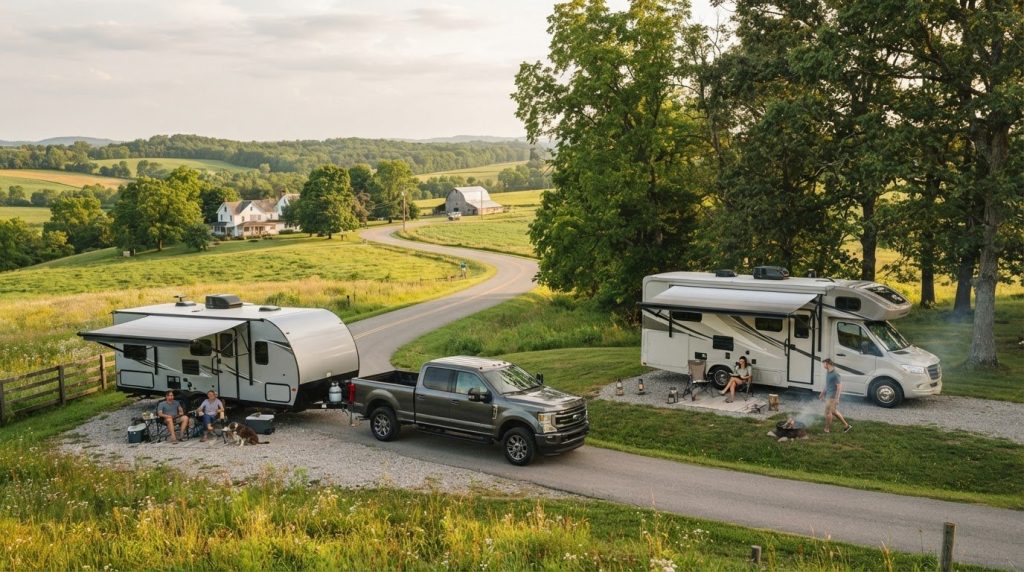
For a first-time renter, choosing between a travel trailer and a motorhome often comes down to towing: a travel trailer needs a suitable tow vehicle, while a motorhome does not. License requirements vary by location and vehicle weight, so your choice also depends on what you’ll drive and where you plan to travel.
Cost matters, but so does how you’ll use the RV day to day. With a trailer, you can leave your living space at camp and take the tow vehicle on local outings. A motorhome combines your living space and transportation, but you’ll drive it whenever you head out. This guide compares costs, driving and towing, and trip needs to help you choose a setup that suits your plans, whether you’re taking a quick getaway or a longer road trip.
Key Takeaways
- Compare the full rental costs, not just the nightly rate; trip-related charges can affect your budget.
- Choose a travel trailer if using your tow vehicle for local outings matters, and a motorhome if you prefer your living space and drive in one vehicle.
- For a travel trailer, make sure your vehicle has suitable towing capacity and that you’re comfortable towing and backing up.
- Match the RV to your trip: group size, route, campground space, and how often you’ll want to drive around all help narrow the choice.
How much does it cost to rent an RV?
Your total depends on the rental terms, trip distance, campground, and RV type. Rules vary by state, campground, and rental company: state requirements may depend on vehicle weight, campgrounds set site limits, and rental companies establish pickup, return, and extension terms.
Fuel, Insurance, and Acquisition Costs
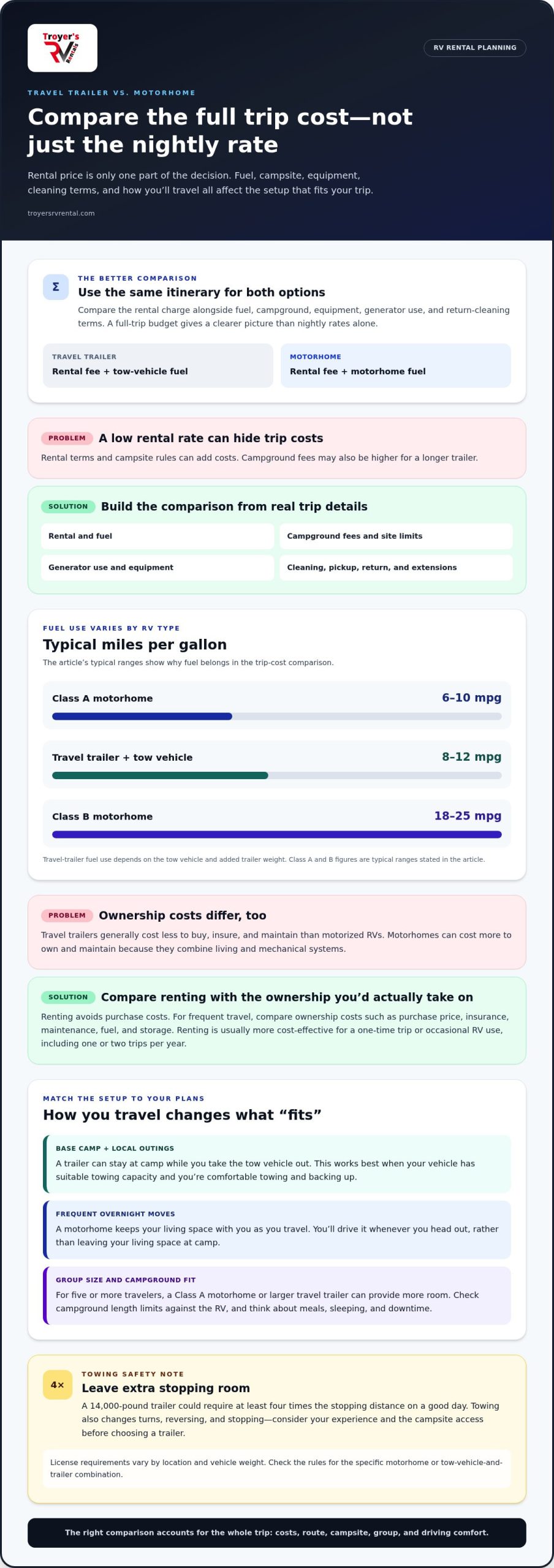
Fuel depends on whether you drive a motorhome or tow a camper. Class A motorhomes typically get 6-10 miles per gallon, while Class B motorhomes typically get 18-25. Towing a travel trailer typically gets 8-12 miles per gallon, depending on the tow vehicle and added trailer weight.
Travel trailers generally cost less to buy, insure, and maintain than motorized RVs. Motorhomes can cost more to own and maintain because they combine living and mechanical systems. Renting avoids the purchase, but insurance, mileage, or deposit charges may add to the rental fee.
Generator, Campground, Cleaning, and Equipment Costs
Break your trip budget into separate costs, such as generator use, campground fees, cleaning, and equipment. These depend on the rental terms and campsite, so include each when comparing options. A longer trailer may also mean higher campground fees because of its length.
To compare options, use the same itinerary for both a trailer and a motorhome. Include the campsite, equipment needs, and return-cleaning terms alongside the rental charge. Comparing the full trip cost gives you a clearer picture than looking at nightly rates alone.
| Option | Rental and fuel | Ownership costs | Trip-cost consideration |
|---|---|---|---|
| Travel trailer | Rental fee plus tow-vehicle fuel | Generally lower acquisition, insurance, and maintenance | Longer units may mean higher campground fees |
| Motorhome | Rental fee plus motorhome fuel | Generally higher acquisition, insurance, and maintenance | Class A, B, and C fuel use differs |
Renting is usually more cost-effective for a one-time trip or occasional RV use. If you travel often, it may be worth comparing ownership, including the purchase price, insurance, maintenance, fuel, and storage.
Compare the full trip budget with the ownership costs you would actually take on.
Renting a travel trailer or motorhome for different trip types
A weekend at one campground and a cross-country tour call for different setups. For a first-time renter, the choice between a travel trailer and a motorhome depends on the trip’s pace: will you stay put or move between stops? A trailer can remain at camp while you take the tow vehicle out. A motorhome keeps your living space with you as you travel.
Group size matters, too. For five or more travelers, a Class A motorhome or larger travel trailer can provide more room. For a short getaway, consider how the layout works for meals, sleeping, and downtime. Picture a rainy afternoon or an early departure, not just the scenic moments, when deciding how much space your group needs.
Renting an RV for the first time lets you try the routine before buying. Notice what works during the trip: where bags go, how easily everyone moves around, and whether you prefer driving one vehicle or towing. The comparison is most useful when it reflects your actual travel habits, not an imagined ideal.
Renting lets you try RV travel without committing to ownership, but the rental period sets the boundaries of your trip. Buying may suit frequent travelers, though it also means taking on ownership costs. If you expect only one or two trips per year, renting is usually more cost-effective.
Before booking, map your route and decide what kinds of stops you’ll make. A trailer can suit a base-camp plan with day trips, while a motorhome may work well for an itinerary with frequent overnight moves. Check campground length limits against the RV, then choose the setup that makes your planned days easier.
Are Any Special Driving Licenses Required to Operate an RV or Tow a Trailer?
License requirements vary by location and vehicle weight, so there is no single rule for every RV. The key difference is that you drive a motorhome directly, while a travel trailer requires a suitable tow vehicle.
Towing Vehicle Requirements
A travel trailer lets you leave your living space at camp and take the tow vehicle out for local trips. That flexibility depends on having a vehicle with enough towing capacity for the specific trailer. Trucks and SUVs can tow some travel trailers, but the vehicle type alone does not show whether a particular match is suitable.
Use your vehicle manual and the trailer’s weight details to assess the match. A motorhome does not require a separate towing vehicle, which may suit renters without a capable truck or SUV. A trailer may work better if you want a separate vehicle for local outings.
Driving and Towing Skills
Towing changes how you handle turns, reversing, and stopping. Travel trailer renters need to feel comfortable towing and backing up before heading into unfamiliar roads or a tight campsite. A 14,000-pound trailer could require at least four times the stopping distance on a good day, so leave extra room and avoid following closely.
A motorhome avoids hitching up a trailer and backing it into place, but you still need to drive the RV itself. Consider its size, your route, and campsite access. Whichever setup you choose, practice low-speed turns and parking before longer road trips.
License rules depend on location and vehicle weight, so a license that covers one RV may not cover another. Requirements vary across the United States. Check the rules for the specific motorhome or tow vehicle and trailer combination rather than assuming the same rules apply to every rental.
With a travel trailer, the kitchen and living area stay at camp when you detach it. A motorhome keeps those spaces with you as you travel between stops. Compare that difference with your route, driving comfort, and need for local transportation.
Choose a setup that fits your vehicle, license requirements, and towing experience, not just your preferred interior.
Motorhome and travel-trailer differences
The main difference is whether your living space moves with you or stays at camp. A motorhome combines the driving area and interior, while a travel trailer is towed and can be detached. For a first-time renter, that choice affects day trips, parking, and campground setup.
Motorhomes come in Class A, B, and C sizes. Class A is the largest, Class B the smallest, and Class C falls between them. Class A motorhomes generally offer the most room and can sleep up to eight people. Class B motorhomes typically sleep two to four, while Class C models can sleep up to six.
A travel trailer’s floor plan and amenities vary by model. Most travel trailers have a full bathroom, and some offer more living space than a motorized RV at a similar price. For travelers exploring spacious towable designs, specialists like Eurocruiser illustrate how modern layouts maximize interior living comfort. However, a longer trailer may be harder to fit into a campsite. Larger motorhomes can also be less maneuverable on narrow roads or in tight parking areas.
| Trip factor | Motorhome | Travel trailer |
|---|---|---|
| Local outings | Take the RV with you, or use a second vehicle | Detach at camp and use the tow vehicle |
| Living space | Class A offers the most room among motorhomes | Floor plan and space vary by model |
| Driving setup | Drive the living space between stops | Tow, park, then set up at camp |
| Campsite fit | Large models need room to maneuver | Length affects which sites can fit |
For a multi-stop outdoor trip, a motorhome keeps your amenities close as you travel, but you may want another vehicle for exploring. For a stay at one base, a trailer lets you leave your living space in place. Route, campsite fit, and local transportation needs matter more than a blanket claim about which setup costs less.
Compare motorhome rental options if keeping your living space with you suits your travel plans.
Troyer’s RV Rental: Motorhome Rentals
Troyer’s RV Rental offers motorhome rentals for travelers who want their living space and transportation in one vehicle. If towing a travel trailer does not suit your plans, a motorhome may be a practical fit for a road trip or an itinerary with changing stops. Camper rentals and monthly RV rentals are also available for different travel plans.
Choose the setup that matches your route, driving comfort, and time away. If a motorhome fits your trip, explore the rental options and contact Troyer’s RV Rental with your plans. You can also visit Troyer’s RV Rental online.
Make Your First Trip a Useful Test
If you’re choosing between a travel trailer and a motorhome for your first rental, consider which setup will make your days easier, from departure to downtime. Think about the moments that matter to you, such as an unhurried breakfast, a flexible afternoon, or a simple arrival. That gives your choice a practical measure, beyond a checklist.
Troyer’s RV Rental offers motorhome, camper, and fishing boat rentals, giving you options for different kinds of outdoor outings. Before settling on a plan, picture the trip’s pace and decide what you want to spend more time doing. Keep the plan simple and leave room for unexpected views and stops.
Ready to plan your next outing? Contact Troyer’s RV Rental and take the next step toward time away that suits you. Your first RV trip can be a relaxed way to learn what works for you.
Frequently Asked Questions
RV vs Travel Trailer: Which One Is Right For You?
Choose based on your route, driving comfort, and how you’ll use your campsite. A motorhome suits travelers who want one vehicle for travel and overnight stays. A trailer may work better if you have a suitable tow vehicle and want to leave your lodging parked. For a weekend in Millersburg, map out your stops and parking needs before deciding.
What is the difference between a travel trailer and a motorhome?
A motorhome is a driveable RV with living space built into the vehicle. A travel trailer is a separate unit pulled by a tow vehicle. This difference affects what you do after reaching a destination: with a trailer, you can unhook and use the tow vehicle for errands; with a motorhome, you drive the RV when changing locations.
How much does it cost to rent a travel trailer versus a motorhome in the U.S.?
Rental cost varies by RV type, vehicle age, trip length, and rental terms, so compare quotes for the same dates and itinerary. Travel trailers may have a lower nightly rental cost than motorhomes, but towing fuel and campground length limits can affect the trip budget. Compare the complete rental total, not only the advertised nightly rate.
What additional fees are common when renting an RV?
Possible extra charges include insurance, mileage, and a refundable damage deposit. The rental agreement explains which charges apply and how they are calculated. Before finalizing a reservation, find out how generator use, cleaning, equipment, and late returns are handled. For a fair comparison, list each charge beside the nightly rental cost for every RV you’re considering.
What driver’s license is required to rent and drive a motorhome or tow a travel trailer?
License requirements depend on location and vehicle weight, so the answer can differ between RVs and jurisdictions. Before your trip, identify the motorhome’s weight or the combined towing setup, then review the rules for where you’ll drive. Rental eligibility and legal driving requirements are separate considerations, so account for both when planning a trip from Millersburg.
What vehicle is needed to tow a travel trailer, and how do I check towing capacity?
You need a tow vehicle with enough capacity for the specific trailer. Start with the vehicle owner’s manual, then compare its towing information with the trailer’s weight details. Don’t assume a truck or SUV can tow a trailer just because of its vehicle type. If the match is unclear, have a qualified professional assess the vehicle and trailer together.